


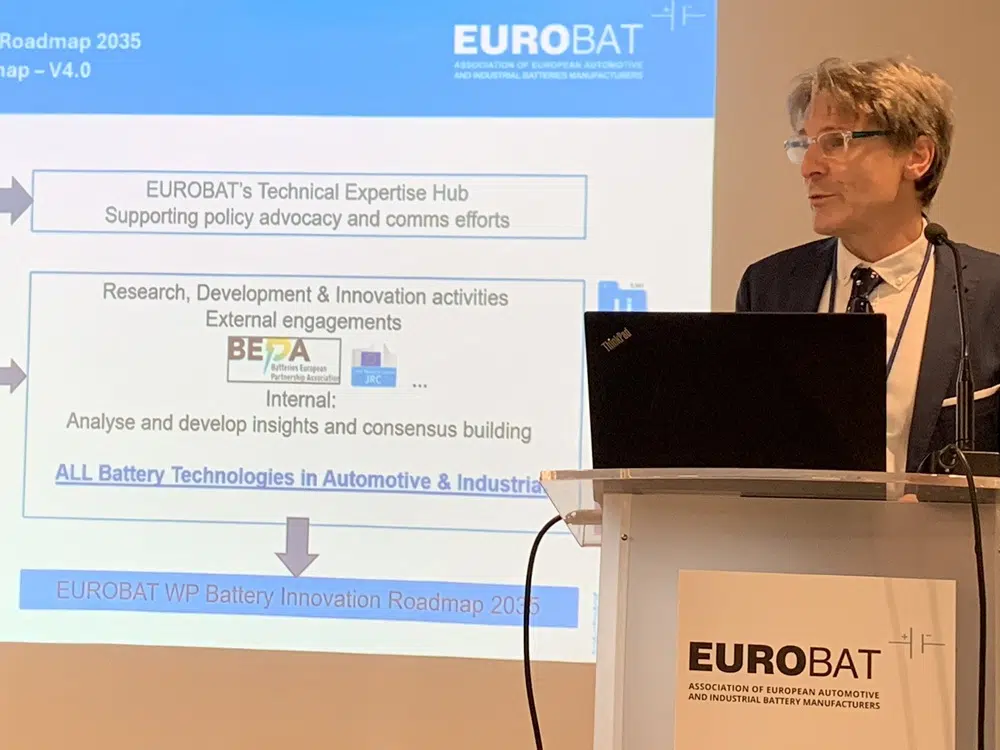
Lithium is set to remain the dominant battery tech over the next decade ― but lead batteries are forecast to remain the second strongest technology, according to a major new report by EUROBAT.
The European battery trade association, which released the fourth edition of its Battery Innovation Roadmap in Brussels on June 17, said lithium is expected to account for about 80% of the market (around 6TWh).
According to the roadmap, lead acid will hold on to a stable market share of roughly 650GWh beyond 2035.
Meanwhile, sodium ion is identified as a key emerging technology that could potentially reach an 8% market share by 2035, competing directly with certain lithium applications.
The roadmap, presented by EUROBAT technical affairs and innovation manager Erwin Marckx, said nickel-based technologies are expected to maintain a stable presence in specific niche markets with specialised requirements.
Market growth is being fundamentally driven by electrification in transport and industry, as well as shifting geopolitical realities regarding supply chain resilience, Marckx said.
Innovation in lithium batteries is moving from LFP to LMFP, with high-nickel chemistries focused on high-energy density and solid-state batteries viewed as a long-term perspective.
Lead technology continues to evolve through advanced designs, including carbon technology, bipolar progress, and secure lead technology for telecommunications and UPS applications.
Sodium ion tech is moving into early commercial applications, particularly in stationary storage and light mobility, despite being more expensive than LFP.
Marckx said the European Battery Regulation is a primary driver for innovation, mandating lower carbon footprints, responsible sourcing, longer lifetimes and full circularity across all chemistries.
EUROBAT will publish the full technical annex of the roadmap online within the next three weeks and the association said its task force innovation experts will continue monitoring technology and market trends to ensure the roadmap remains updated.
The roadmap is entirely industry-driven, reflecting consensus and insights from battery manufacturers, system integrators, and associate members across the value chain, EUROBAT said.
The document is structured into two parts — a main document intended for policymakers and a full technical annex for the research community and technology developers.
A detailed review of the roadmap will be published later by Batteries International.