

Australia is now the world’s third largest market for utility-scale batteries, behind only China and the US, according to a report from the country’s Clean Energy Council (CEC).
Battery costs fell by 20% during the past year, as committed large-scale battery capacity grew 233%, with a record 4.3GW worth A$4.8 billion reaching financial commitment — up 10% on 2024.
The report was published on May 26 — a day before RWE received official sign-off from the Australian Energy Market Operator and Transmission Network Service Provider Transgrid to operate Australia’s first eight-hour BESS at full capacity in New South Wales.
But while the CEC report said 2GW of capacity was commissioned in 2025, more than triple the volume added in the previous year, several investment barriers remain and are holding back billions of dollars in private capital waiting to invest in new solar and wind farms needed for a resilient and diversified energy system.
According to the report, Clean Energy Australia 2026, more than 4.3 million Australian homes now have rooftop solar, with 2.6GW of new rooftop capacity installed in 2025.
A further 5.9GW of large-scale wind and solar was commissioned in 2025, adding significant new supply to the national grid, with a 28.5% increase on 2024.
Clean energy — solar, wind, hydro and battery storage — now power nearly half of Australia’s electricity needs, CEC said.
However, only 2.3GW of new utility-scale solar (1.4GW) and onshore wind (0.9GW) reached financial commitment in 2025, down 46% year-on-year.
CEC chief executive Jackie Trad said 2025 was a year of new records, with more renewable energy, more batteries and more households generating their own power.
“Australia’s clean energy transition is at a critical juncture. Renewables are supplying nearly half our electricity; we are now a top-three global player in big battery storage and households are taking control of their own power bills in record numbers.
“But we need to be honest about where we are, and where we need to be. The number that demands attention is going in the wrong direction: financial commitments for large-scale wind and solar is at a decade low. That is a gap we must close.”
Batteries International reported last October that RWE Renewables Australia was preparing to commission the country’s first eight-hour BESS.
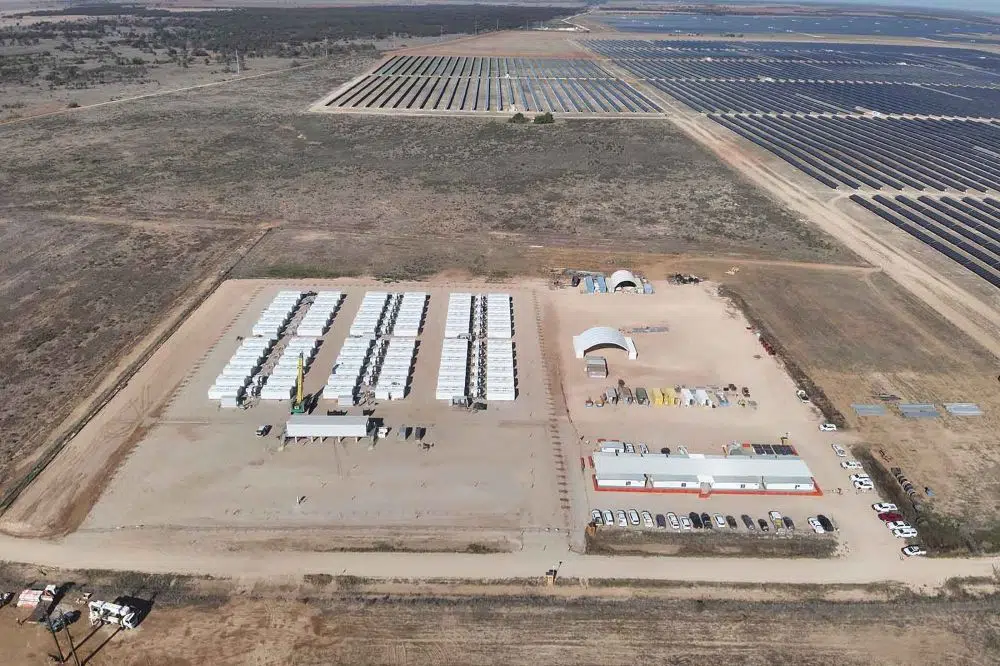
The Limondale BESS, comprising 144 Tesla Megapack batteries, has a capacity of 50MW/400 MWh, which the company said will make it the longest-duration grid-scale battery operating in Australia.
Sopna Sury, CEO of RWE Renewables Europe & Australia, said on May 27: “This groundbreaking project transforms battery storage in Australia, marking a significant milestone in the development of long-duration energy storage and enhancing the reliability and resilience of the national energy system.”