
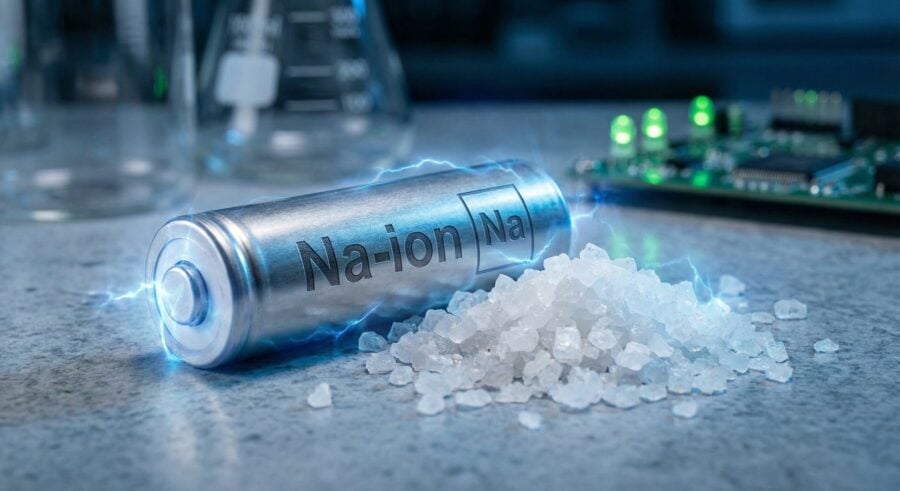
General Motors announced on June 7 it is to partner Peak Energy on domestically manufactured sodium-ion batteries for grid-scale energy storage. The decision may prove to be about far more than battery chemistry.
At first glance, the announcement is a technology story. GM and Peak Energy will work together to develop sodium-ion battery systems for stationary energy storage, with development work centred around GM’s battery facilities in Michigan and commercial production targeted for 2028.
But beneath the chemistry lies the question bugging the US battery industry: how can American companies build competitive battery supply chains while reducing their dependence on China?
The answer is becoming increasingly important as battery manufacturers, automakers and energy storage developers grapple with evolving Foreign Entity of Concern (FEOC) rules, domestic-content requirements and growing geopolitical uncertainty.
In many ways, GM and Ford have arrived at very different answers to the same question.
Ford has been the nimbler to act. Ford Energy, a wholly owned subsidiary of the automaker, recently signed a five-year framework agreement with EDF Power Solutions for up to 20GWh of battery energy storage systems.
The company plans to repurpose former electric vehicle battery manufacturing capacity in Kentucky to build standardized energy storage systems for utilities, data centres and industrial customers.
The technology at the heart of that strategy is lithium iron phosphate (LFP), licensed from Chinese battery giant CATL.
Ford originally announced plans for its CATL-based LFP manufacturing strategy in February 2023, arguing that the arrangement would allow the company to bring proven, lower-cost battery technology to the US market while retaining ownership of domestic manufacturing facilities.
It is the fast-to-market route: established chemistry, proven manufacturing processes and a technology platform that has already been deployed at scale around the world.
GM is taking a different path. Rather than relying on a mature battery technology developed elsewhere, the company is backing an emerging chemistry that many believe could become a major player in stationary storage over the next decade.
Peak Energy believes sodium-ion’s greatest opportunity lies not simply in replacing lithium-ion cells but in redesigning the architecture of battery energy storage systems.
Founded by industry veterans from Tesla, Enovix and Apple, the company has developed a battery energy storage system based on a fully passive cooling design. According to Peak, the technology eliminates many of the components required in conventional lithium-ion installations, reducing complexity while improving safety.
Unlike most lithium-ion systems, which rely on active thermal management systems involving pumps, cooling circuits and monitoring equipment, Peak says its sodium-ion architecture can operate without active cooling. The result is fewer moving parts, lower maintenance requirements and reduced operational costs over the system’s lifetime.
The company also argues that sodium-ion batteries experience less degradation than many lithium-based chemistries when deployed in stationary applications. This can potentially translate into longer service life and lower operating and maintenance costs for utilities and storage developers.
Peak has previously claimed that its design could reduce lifetime project costs by more than $100 million for a typical utility-scale deployment. While such projections remain to be demonstrated at commercial scale, they illustrate the economic potential supporters see in sodium-ion technology.
There are other attractions too. Sodium-ion batteries avoid many of the critical mineral concerns associated with lithium, nickel and cobalt supply chains and are potentially less exposed to the supply-chain dominance China currently enjoys in lithium-ion manufacturing.
For grid-scale storage applications, where weight and energy density are less critical than cost, safety and durability, sodium-ion’s limitations become far less important.
The FEOC factor
The timing of GM’s announcement is particularly significant because of the growing influence of FEOC regulations.
Designed to reduce US dependence on Chinese-controlled supply chains, FEOC rules are becoming increasingly important for companies seeking access to federal incentives, manufacturing credits and other support mechanisms created under recent industrial policy initiatives.
The precise interpretation of FEOC requirements continues to evolve, but the direction of travel is clear: policymakers want more battery manufacturing, more battery technology and more battery supply chains located within the United States or allied countries.
That has created a strategic challenge for companies relying on Chinese technology.
Ford’s CATL arrangement was carefully structured as a licensing agreement rather than a joint venture. Nevertheless, projects linked to Chinese intellectual property, equipment or supply chains continue to attract political scrutiny as FEOC guidance develops.
By contrast, GM’s sodium-ion partnership with Peak Energy offers the prospect of a battery technology developed, manufactured and deployed within a largely domestic ecosystem.
That distinction could become increasingly important as energy storage developers, utilities and financiers seek certainty around future regulatory compliance.
Viewed through that lens, the real distinction between Ford and GM is not chemistry but risk allocation.
Ford has chosen execution certainty. Its CATL-derived LFP technology is proven, widely deployed and supported by one of the world’s largest battery manufacturers. The strategy minimizes technical risk and should help accelerate commercial deployment.
However, it may leave Ford more exposed to future questions surrounding FEOC regulations, domestic-content requirements and dependence on Chinese intellectual property.
GM’s strategy carries a different set of risks. Sodium-ion remains relatively unproven at utility scale and must still demonstrate long-term performance, degradation characteristics and commercial competitiveness over the 15- to 20-year operating lives expected by grid operators and infrastructure investors.
Yet if successful, it could provide a more resilient domestic supply chain with reduced exposure to lithium markets and Chinese manufacturing dominance.
Importantly, GM is not abandoning lithium-ion altogether. The company continues to pursue LFP production for energy storage through its Ultium Cells partnership with LG Energy Solution, effectively hedging its bets while sodium-ion technology matures.
The wider industry is watching closely. A growing number of energy storage developers have sought to diversify supply chains and reduce reliance on Chinese imports, although most continue to depend heavily on lithium-ion technology.
At the same time, several sodium-ion developers in North America and Europe are positioning their technologies as alternatives to China’s dominance of battery materials and manufacturing.
Whether sodium-ion ultimately fulfils those expectations remains uncertain. What is clear is that utilities, data-centre operators and project financiers are increasingly evaluating battery systems through a broader lens than simple chemistry.
The critical questions are becoming: will the technology be available when required, qualify for incentives, comply with regulations, carry bankable warranties and remain financeable throughout its operating life?
Those are the factors that determine which technologies succeed and which fail.
Chemistry may grab the headlines. But for the customers writing the cheques, bankability remains the deciding factor.
IMAGE CREDITS: Adobestock