


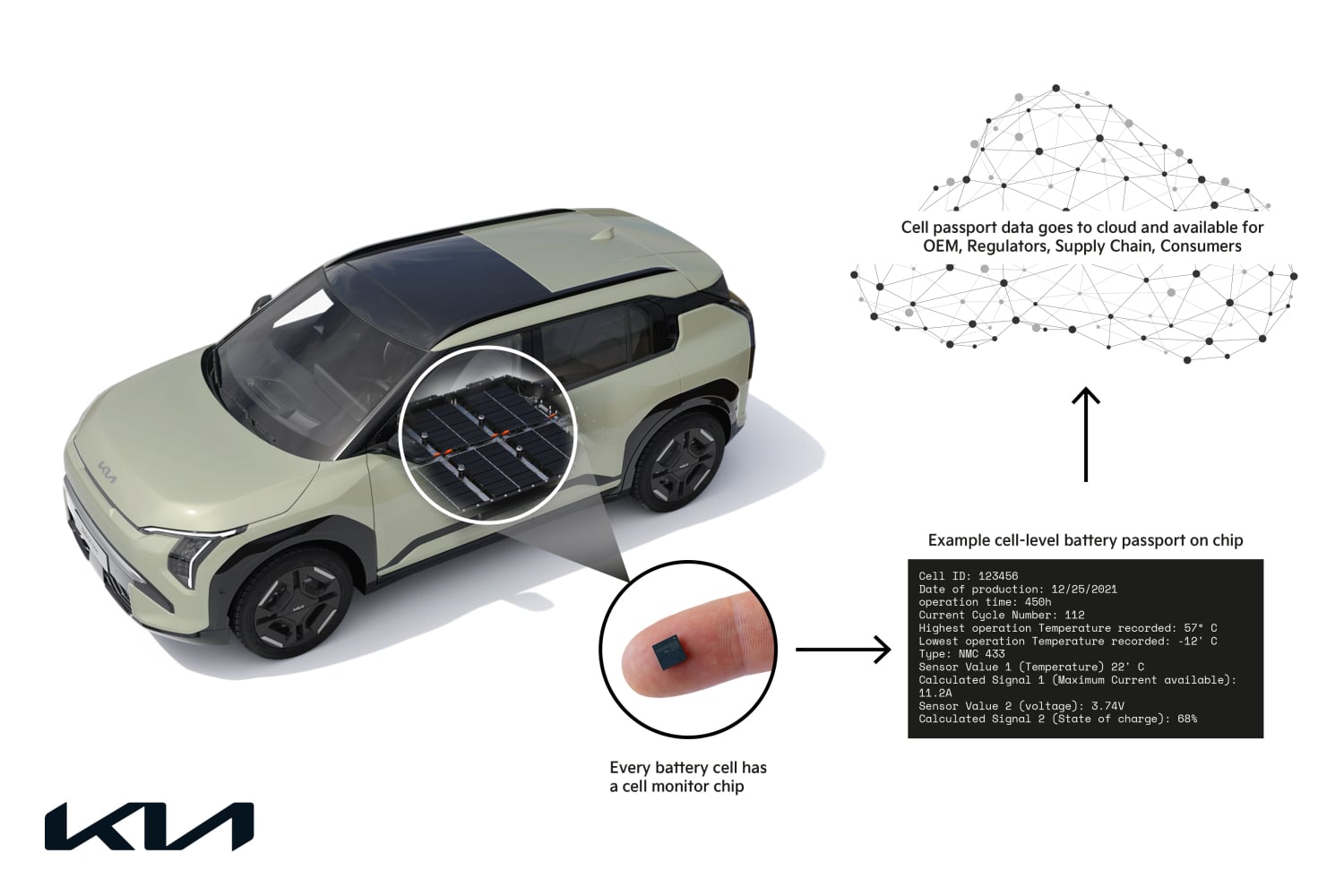
Why a progression from pack-level monitoring to cell-level traceability enhances reliability, sustainability and circular economy
By Joseph Notaro, Chief Revenue Officer at Dukosi
Regulation can often be seen as a constraint – a series of boxes to tick, thresholds to meet, or certifications to file. Yet in certain industries, it has repeatedly acted as a catalyst for progress. The automotive sector is one such industry: emissions standards such as Euro 5 and Euro 6 drove fundamental changes in engine design, while numerous safety regulations mandated features like airbags and electronic stability control.
For electric vehicles (xEVs), the European Union’s Battery Regulation together with other broader standards, represents another instance where regulation is driving a tangible impact – shaping how the next generation of automotive batteries are designed, manufactured, monitored, and managed throughout their lifecycle.However, achieving the aims of this regulation is far from trivial. Compliance requires coordinated action across the entire supply chain with multiple stakeholders, including OEMs, technology providers, regulators, and researchers, with current battery systems lacking the data granularity necessary to meet the requirements.
With the regulation’s 2027 implementation date rapidly approaching, the industry is actively developing and testing new approaches to capture, manage, and share the detailed battery information required. In this article, we guide you through the key elements of the battery passport, the technical and organizational challenges it presents, and how Dukosi’s innovative cell monitoring system (DKCMS™) is helping to support industry-wide progress that delivers measurable value.
Regulatory Requirements and Their Implications
The Global Battery Alliance (GBA), launched in 2016, set out a clear ambition: to establish a sustainable, transparent, and responsible battery value chain by 2030. That vision moved decisively into the regulatory domain in July 2023, when the European Council approved the European Union Battery Regulation (Regulation (EU) 2023/1542), introducing a common framework for batteries placed on the European market.
At the center of this framework is the requirement that all new EV and industrial-use batteries with a capacity above 2 kilowatt-hours (kWh) must carry a unique digital battery passport by February 1, 2027. This passport is intended to act as a persistent, trusted record that follows the battery throughout its lifecycle. The DIN DKE SPEC 99100 standard, published in January 2025, further defined the technical specifications for the battery passport, including mandatory and voluntary data attributes.
This framework establishes a new expectation for batteries: the passport must encompass more than one hundred data attributes, combining static information such as battery chemistry, origin, and recycled content with dynamic operational data including State of Charge (SoC) and State of Health (SoH). Crucially, this information must remain accurate, traceable, and trustworthy over many years of operation, across ownership changes, and through potential reuse or repurposing.
Fundamentally, this shifts the role of battery data. The battery passport is not intended as a static compliance record, but as a living description of a battery’s condition and provenance over time. For vehicle owners and fleet operators, battery health, usage history, and residual value are no longer inferred or determined through inspection, but are directly accessible and comparable. For automotive OEMs, it enables more robust lifecycle management, clearer warranty positioning, and credible pathways into repair, reuse, and second-life deployment. At the system level, it also allows authorities and recycling organizations to move from estimation to verification, strengthening safety oversight and circular-economy outcomes.
In this sense, the regulation reframes battery data as shared infrastructure rather than private telemetry, with implications extending well beyond the point of sale.

This is where the implications for today’s battery systems become clear. Most existing battery management architectures monitor batteries at the pack or module level rather than tracking individual cells. Under the DIN DKE SPEC 99100 standard, only the overall battery SoH will need to be recorded. However, the SoH remains valid only if the battery pack and its embedded battery management electronics remain intact. Removing a cell or BMS component invalidates the reading, limiting maintenance options and undermining second-life and circular-economy use cases. Ideally, this challenge is addressed through cell-level traceability.
Nevertheless, closing these gaps is not simply a matter of adding new software layers or reporting interfaces. Meeting the technical and organizational demands of the battery passport requires coordinated action alongside innovative approaches capable of capturing and retaining reliable data at a much finer level of granularity.
Trial and Technical Responses
To explore practical implementation, a demonstrative Europe-wide trial is launched, bringing together academic, industrial, and governmental participants, including Delft University of Technology (TU Delft), the Hyundai Motor Europe Technical Center (HMETC) along with Hyundai Mobis and Kia Europe, the Netherlands Organization for Applied Scientific Research (TNO), and the Dutch producer responsibility organization ARN, as well as Dukosi and the EU-funded Datapipe project[1]. The aim of this collaborative framework is to evaluate both technical and organizational aspects of the battery passport under real-world conditions, providing insights that can inform broader industry adoption.
The trial features a Kia EV3 equipped with the Dukosi Cell Monitoring System (DKCMS). This innovative, contactless battery architecture enables DK8102 Cell Monitors to be fitted to each battery cell, providing and storing granular insights, like cell SoH[1], while reducing complexity and potential failure points compared with traditional wired monitoring systems. Each monitor integrates a high-accuracy analog front end (AFE), digital signal processing, a microcontroller (MCU), memory, a temperature sensor, and a near-field transceiver. It measures voltage and temperature directly at the cell and transmits it contactlessly via Dukosi’s C-SynQ® protocol to a DK8202 System Hub.
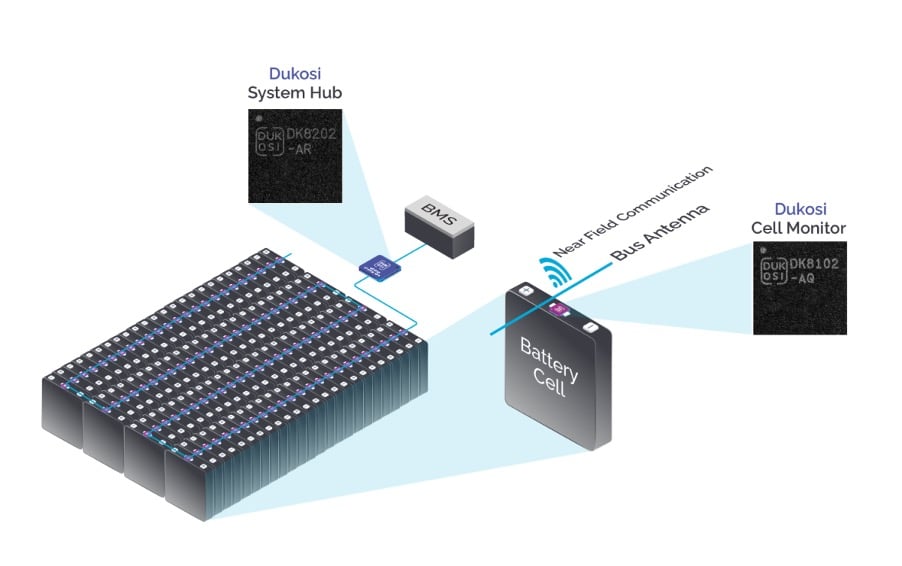
During the real-world vehicle tests performed in the project, the Dukosi System Hub aggregates information from all cells and passes it to the BMS, which routes it to the vehicle’s modified infotainment system, and then onward to cloud services or TNO-developed sharing environment. This enables regulators, OEMs, and research partners to access the data remotely while maintaining integrity. This setup allows all stakeholders to observe how the battery passport requirements function in practice, testing both technical feasibility and data governance under real-world conditions.The trial reveals several key insights. Technically, it shows that cell-level monitoring enables continuous, high-resolution data collection while maintaining safe and reliable battery operation. Accurate, persistent data at the cell level supports compliance with the battery passport requirements, ensuring that SoC, SoH, and provenance information remain trustworthy throughout the battery’s lifecycle. Organizationally, the project highlights that coordinated data access, clear governance, and defined responsibilities are essential for regulators, OEMs, and service providers to act effectively on the information.
Regulation as Architectural Driver and Source of Value
The EU Battery Regulation is more than a compliance measure – its true intention is to create a trusted, persistent record of battery condition and provenance for the benefit of all. However, capturing comprehensive, accurate and traceable data across a battery’s lifecycle cannot be reliably achieved through pack- or module-level monitoring alone. Realizing this vision requires embedding intelligence at the cell level, ensuring data remains valid through disassembly, maintenance, and potential reuse, while remaining securely accessible to all relevant stakeholders.
DKCMS illustrates how this can be achieved, supporting regulatory compliance and beyond. By embedding monitoring directly on each cell and providing a robust communication and storage framework, it demonstrates that not just the battery passport, but a cell-level passport is a practical, implementable system. The real-world trial with the Kia EV3 demonstrator shows that this approach enables continuous, high-resolution data capture and access while maintaining safe and reliable battery operation.
The benefits of battery- and cell-level passports are substantial. Vehicle owners and fleet operators gain actionable insight into battery health, supporting informed decisions on usage, maintenance, and resale value. Manufacturers benefit from clearer lifecycle management, improved warranty strategies, and a credible pipeline to second-life applications. Persistent, accurate data strengthens the long-term performance and safety oversight during a lifetime of usage, before eventual recycling and material recovery, making the environmental and operational benefits of electric vehicles both verifiable and tangible.
Conclusion
The EU Battery Regulation sets a clear direction of travel, shifting battery data from private telemetry to shared infrastructure that underpins safety, sustainability, and trust throughout the value chain. Meeting this ambition depends not only on policy, but on battery architectures capable of preserving accurate data over a battery’s full operational life.
The aforementioned trial demonstrates that this is already achievable in practice. By combining regulatory intent, collaborative implementation, and Dukosi’s cell-level monitoring through DKCMS, the project shows how traceability requirements can be met without adding system fragility or operational burden. More importantly, it highlights how compliance and value creation are not competing objectives. When regulation is a technological driver rather than a reporting exercise, it can accelerate better system design, enabling batteries that are not only compliant, but verifiably safer, more transparent, and more sustainable throughout their lifecycle.