

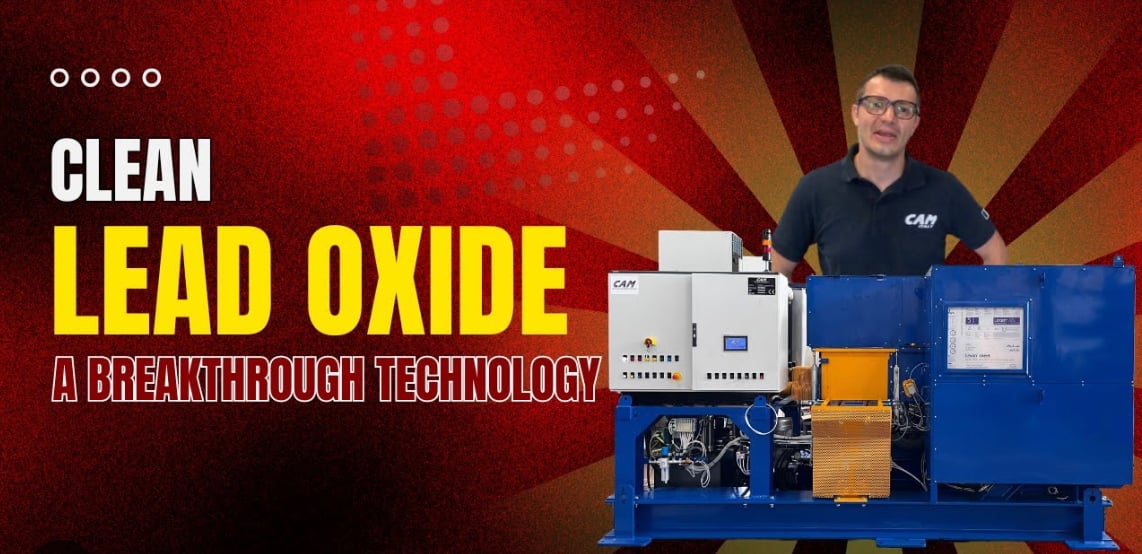
As CAM exclusively reveal plans for a new division dedicated to lithium recycling, we talk to Francesco Marfisi — part engineer, part YouTube sales star — about his mission to continue evolving a traditional family firm into an industry leading global player.
Francesco Marfisi, nephew of the founder of CAM, an Italian manufacturer of industrial equipment for the lead acid battery industry, is, by his own admission, a bit of a Jekyll and Hyde.
With one hat on, he is clearly a gifted engineer, a graduate in electrical engineering who, in his own words, was ‘born’ into the company, working on the production line as a summer job in his teens.
Fast forward over two decades and he has now successfully carved himself a niche as a lead battery communications guru with his own YouTube channel where he describes his goal to bridge engineering and business.
On this channel he takes viewers on a kind of behind-the-scenes of his professional life, as the self-billed ‘Engineering Salesman.’ For readers he will even engage with his own magazine (cover shown here).
It’s all quite avant-garde for the dry world of lead oxide mills and curing chambers, but Francesco is a man on a mission to show the world that engineering isn’t just about theories and formulas, but ‘endless opportunities’.
“I try my best to share our knowledge because I am the face of the company,” he says. “It’s important today, in 2026, to share not only the product and service we have because that’s only the tip of the iceberg.
“There is so much more to learn about, cost, new technology and the market. Sometimes this market is known as an old industry but it’s crucial to improve, move with new technology, new ways to save money and cut energy. There are a lot of things to do.”
The company was founded in 1967 by Armando Marfisi, who was later joined by his brothers Bruno and Fernando. Today, Fernando is the CEO, but it is the younger Marfisi’s, Francesco and his brother, Matteo, who are driving the firm’s sales and innovation.
“Matteo is the technical director,” says Francesco. “He’s a mechanical engineer and he’s the one who developed our patented lead shaver.”
It is this lead shaver that is undoubtedly the star of CAM’s product portfolio. A mechanical device with a cutting tool and a rotating shaft, it shaves perfect cylindrical flakes off a lead ingot, eliminating the need for a traditional, (energy consuming) melting process.
For such a game-changer in the oxide manufacturing world, Francesco explains that, perhaps predictably, the original light-bulb moment happened over a bowl of pasta.
“My uncles were on a business trip and had pulled over, tired, to have some lunch,” he says. “Fernando watched as a waiter grated a generous portion of Grana Padano cheese into his bowl. And at that moment a spark ignited in his mind.
“‘Why can’t we grate lead ingots just like that?’ he asked his brother. Armando, ever the pragmatist, listened intently, and together they began to sketch out a revolutionary new machine.”
Even before the lead shaver, CAM had, for decades, been at the forefront of lead battery technology, modernizing the industry with their innovative ball mills and curing chambers.
“The advantage of the ball mill is to have real stability of the oxide,” he says. “The oxide and the plates are the heart of the battery. If you have a great plate, you will have a guaranteed battery. If you don’t have good oxide and good plates, you won’t have a good battery.”
Marfisi is understandably buoyant about CAM’s position in the market but it’s clear his real passion lies in communicating the company’s mantra of ‘built to last a lifetime’.
“Our approach is to focus on the TCO (total cost of ownership) and not just on the Capex,” (capital expenditure) he says. “TCO is a topic a lot of managers don’t understand very well, because they are so often focused on the break-even point in six months to one year, and they want a very short payback.
“But what I keep telling purchasing managers is that those who sell you on low price are hiding the TCO. They count on your distraction regarding maintenance costs, spare parts availability, and long-term reliability. They sell you a machine that works during tests but reveals itself as an ‘Achilles’ heel as soon as it’s subjected to the stress of continuous 24/7 production.
“Chasing initial savings is, in fact, signing up for a 10-year subscription to sudden breakdowns and uncontrolled production scrap.”
The physics of profit: the CAM method and TCO engineering
“At CAM, we don’t design machines to be cheap; we design them to generate constant wealth,” he says. “Let’s analyze the real data for a plant with a production capacity of around 24,000kg/day (~1 tonne/hour) optimized for the European market.
With a conservative contribution margin of €0.50/kg, the value of lost production is €12,000 per day. This is where the technical difference between a CAM plant and a cheap one becomes a matter of corporate survival.
Reliability and downtime: A cheap plant suffers an average of 18 days of downtime per year, compared to only five days for a high-quality CAM system.
The impact of failure: Over 10 years, this gap translates into a staggering production loss of €2,160,000 for the cheap machine versus €600,000 for CAM.
Quality and scrap: CAM’s engineering precision keeps scrap costs to ~€100,000 over a decade, while the approximate tolerances of “cheap” competitors quadruple this figure to €400,000.
Maintenance drain: A low-cost system requires continuous intervention, pushing maintenance and spare parts costs to €700,000 over 10 years, whereas CAM stays at €600,000.
The math is hit-you-in-the-gut simple: the cheap machine saves you (apparently) €475,000 on the purchase price.
However, it presents a final bill of €1,485,000 more than a CAM plant over a decade. Investing in CAM means eliminating the risk of losing over 1.5 million euros in lost production alone.
Francesco acknowledges that the most common objection he comes across is that a CAM plant costs significantly more upfront. “Yes. But this is a technically correct statement that is economically irrelevant. Those who reason only in terms of Capex ignore the brutal reality of Opex,” he insists.
“Claiming a quality plant costs too much is like saying a quality parachute costs too much: the price is irrelevant if it fails to perform when needed. A plant that costs less but stops three times as often is not an investment, it is a financial liability.
“The stability of the oxide production process is the heart of your battery; compromising that heart to save a fraction of the total budget is a mistake your industrial accounting will never forgive.”
It’s a message that’s hard to ignore. Another is the revelation from Francesco that, over the next year, CAM has big plans to expand into the lithium recycling market with a new division to be called TITANAX.
“I will be developing the marketing and strategy of the new company, which will still come under the CAM umbrella, and we are currently in the study and development phase,” he says.
What he does reveal is that the name, TITANAX, sprung from the very same company motto: ‘To last a lifetime’ that has always underscored their success in lead battery manufacturing.
“Titanium is a very strong metal, and “ax’ because the machine will be for axial rotation.”
We can only wait with bated breath to see what this next stage in CAM’s journey will bring. If Francesco has anything to do with it, we’ll be regularly updated via billboards in Times Square, Ted Talks and, quite probably, a blockbuster movie about black mass.
After all, as the champion of communication for the battery manufacturing industry — why on earth would he stop at YouTube?
It could cost you millions …
“The silence of a stopped production line is the most expensive sound an entrepreneur can hear,” says Francesco. For a battery manufacturer, that silence isn’t just a technical break, it’s a financial haemorrhage draining margins, destroying planning, and eroding market competitiveness.
Every hour lead doesn’t flow and oxide isn’t produced, your capital evaporates under the weight of fixed costs that never sleep. Many convince themselves that success starts with saving on the initial purchase (CAPEX), but operational reality punishes this short-sightedness with mathematical violence.
The true enemy of your profit isn’t a high initial investment, but the deceptive promise of “low-cost” solutions, often of low construction quality. Sellers of these plants bet everything on the immediate gratification of a lower price tag, leading you to believe a lead oxide production plant is a simple commodity. It is not.”