

In a city few outside China know, battery giants are building a complete battery ecosystem at a pace that challenges Western assumptions about sovereignty, competitiveness and the future of the industry.
Hans Eric Melin, MD of Circular Energy Storage, visited Yichang and reveals how the astonishing speed of its rise offers an uncomfortable lesson in scale, coordination and the limits of Western industrial policy.
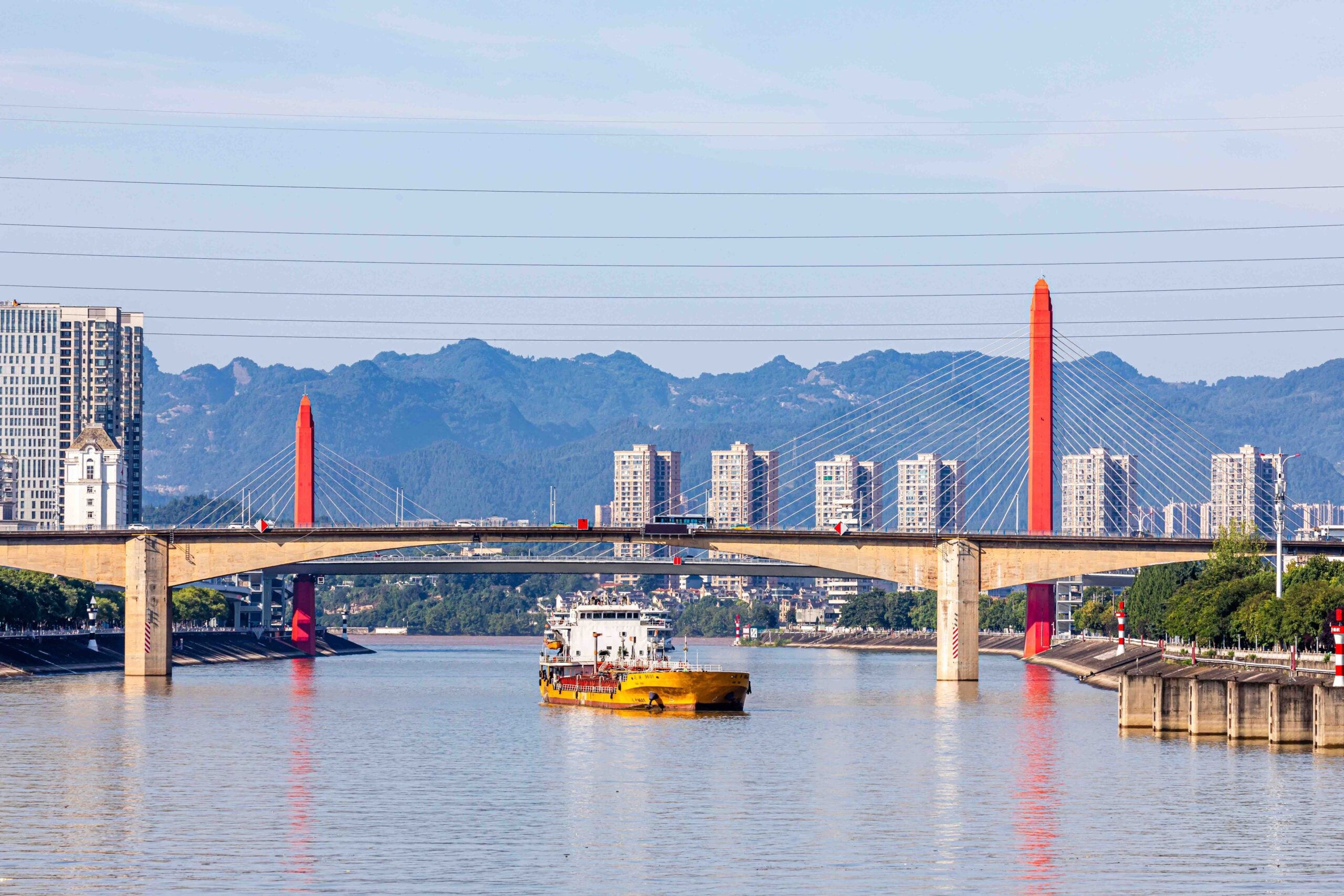
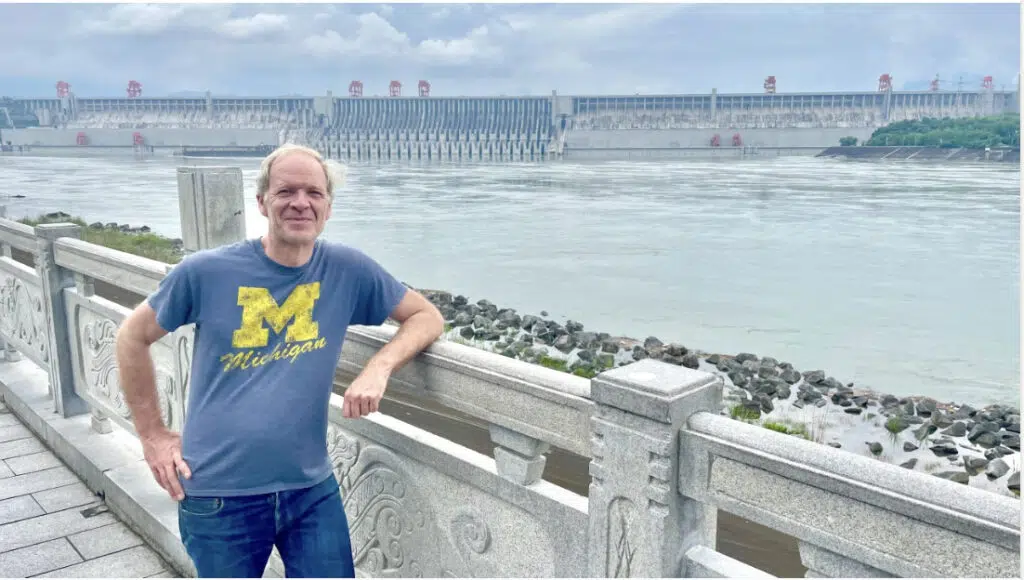
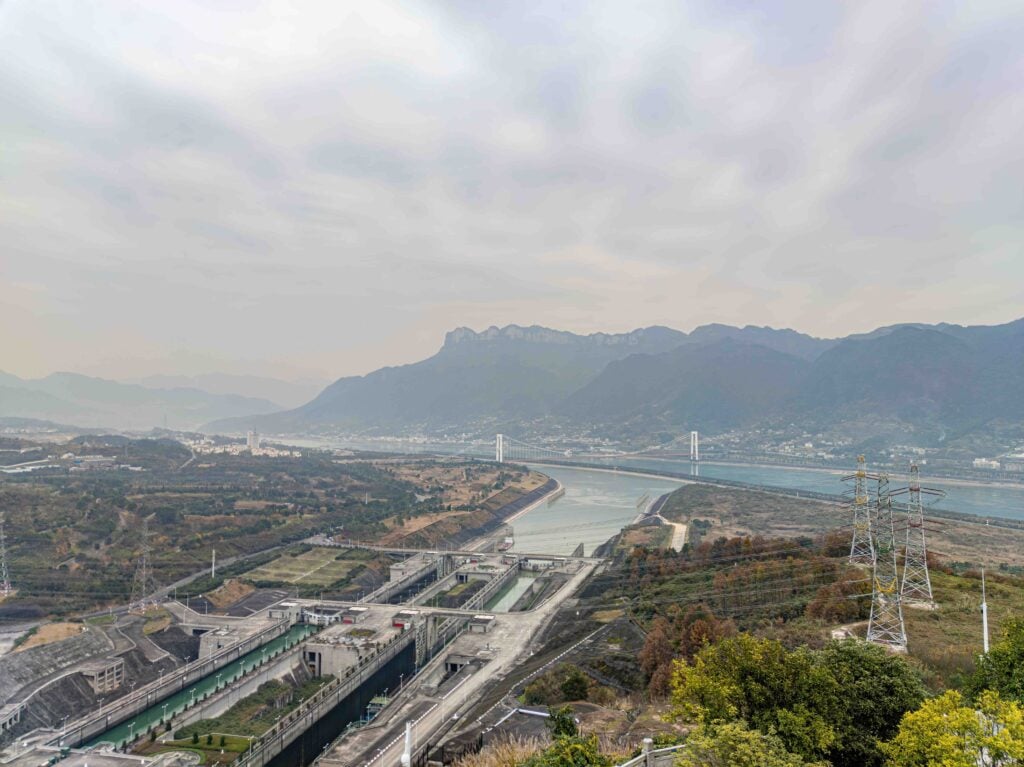
This week I was in Yichang, a city of 3.9 million people in Hubei province. Outside China it is not especially well known. You may know the Three Gorges Dam, the world’s largest hydropower plant, which sits just upstream and produces more electricity than Austria consumes in a year.
You likely don’t know that Yichang is also one of the largest phosphate basins in China, sitting on the Yangtze with direct shipping access to Shanghai, and that it is in the process of turning that geology into one of the most concentrated battery and battery materials clusters in the world.
I was invited by the municipality of Yichang to speak at the International Energy Storage Battery Conference as an expert on battery circularity. What I saw is worth describing in full, because it shows how detached the European and American discussion has become from the realities of scaling the battery industry and the meaning of sovereignty and independence.
The scale
Yichang already has more than 100 GWh of battery cell production capacity in operation or under construction. CORNEX is building toward 145 GWh on a single site. Envision AESC is investing RMB 24.2 billion in 100 GWh of large-format storage cells. Sunwoda’s joint venture with Dongfeng is producing EV cells at 30 GWh.
On the materials side, Brunp — the CATL subsidiary — went from signing a contract in January 2025 to operating a 450,000 tonnes-per-year LFP cathode plant in December of the same year. Eleven months.
Yihua Group has filed environmental assessments for 1.6 million tonnes per year of LFP cathode capacity on top of that. Tinci is building iron phosphate at 300,000 tonnes per year. Recycling capacity at the CATL Brunp park is being expanded by another 300,000 tonnes per year of LFP battery throughput.
This is one city. It is not Shenzhen, not Ningde, not Changzhou.
It is a place most people outside of China have never heard of, building an integrated value chain from phosphate rock through cell to recycled material on the bank of a river that connects directly to the global market.
The clarity
What was just as striking as the scale was the alignment. Province, municipality, banks, and companies are reading from the same page. Every actor knows what Yichang is becoming and what their role in it is.
That clarity is what gives companies the confidence to commit billions to projects that move from signing to commissioning in under a year.
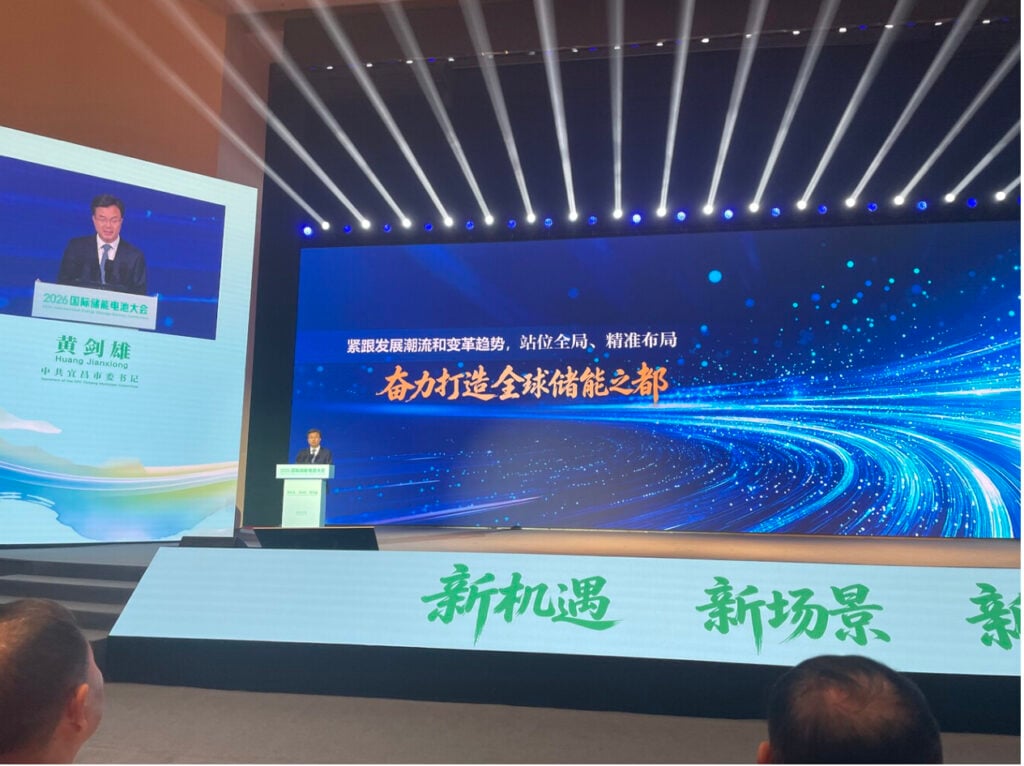
Before the conference, I was invited for tea with Huang Jianxiong, Secretary of the CPC Yichang Municipal Committee. Polite, ceremonial, as these meetings tend to be.
The next morning he opened the conference with a speech that laid out a clear vision: a region built on the world’s largest hydropower plant and one of China’s largest phosphate basins, positioning itself as a centre of the global energy storage industry, with decarbonisation as the organising principle — both decarbonising the battery industry itself and capturing the opportunity created by the world’s need to decarbonise. He then stayed for the whole morning session.
So did the mayor’s office. They listened to technical experts on cathode chemistry, ESS fire mitigation, and cell innovation until lunch.
I have sat through many conferences in Europe and the US where a politician arrives to deliver opening remarks while a stressed press secretary waits by the stage to pull them out to the next event with a new script in hand.
In Yichang the politicians were the audience for the engineers.
At dinner the night before, I was seated with the founder of Brunp, the leadership of Dongfeng Motors, Envision AESC, Sunwoda, Tinci Materials, the China Three Gorges Corporation, Yunnan Energy New Materials, and the heads of several other large battery companies, alongside the political delegation. Behind us, a screen ran footage of the dam, of automated cell lines, of robots disassembling battery packs.
Dishes arrived at a pace that left no room to drift; conversation moved from technology to commercial terms to project timelines and back again, in the same polite, well-organised register that runs through everything in China. There is no country where I feel a stronger commercial appetite than in China right now.
The interest in making deals, finding partners, opening markets, building businesses is everywhere. This is not a system winding down on past success. It is a system pushing outward.
Dan Wang’s recent book Breakneck argues that China is run by engineers and America by lawyers — and Europe, one might add, by bureaucrats. After this week, I would not argue with him.
The execution
Yichang is not only vision. It is the power of execution — vision rapidly translated into capacity, with the whole ecosystem scaling together and talking to each other while it scales.
It shares that dedication to execution with the rest of China. A few days before Yichang I was in Guangdong. I visited three LFP recycling sites and several pCAM and cathode plants. Every one of them was discussing expansion, partnerships, offtake, joint ventures, export markets.
One was a joint venture between GEM and the carmaker GAC for direct recycling of cathode material — 25,000 tonnes per year of electrode repair capacity. At CES we covered the announcement two years ago. The plant is now operational, and it is among the most modern facilities of its kind I have seen anywhere.
The cell plants I visited had automation levels and scrap rates that European producers would struggle to match.
That alignment shows up in lived experience too. In Shenzhen last week, 80% of the cars I saw on the streets now were electric. Deliveries arrive by drone. The air is clean, the streets are quiet, and the quality of life that comes from electrification and clean energy is something you can see and hear with your own eyes and ears.
This is what alignment between policy, capital, and industry actually produces.
What this means for the West
I am not interested in being the bore who declares the race over. The race is not over. But the gap is not the kind of gap that gets closed by a subsidy programme or a directive.
China is not slightly cheaper or slightly faster. On the dimensions that matter — manufacturing capability, integration of the value chain, speed from decision to operation, political alignment behind industrial outcomes — China is operating at an order of magnitude that Europe and the US are not. And the gap is widening every month.
This is the context in which I want to push back on a broader idea that runs through European policy debate: that the way for Europe to capture value from the energy transition is to build, at scale, what China already builds — cells, materials, and recycling — and that doing so will deliver strategic independence.
We are chasing the wrong kind of independence, and in doing so we stumble and lose resources at the same time.
European and American industry will not out-produce its Chinese equivalents on cells, cathode material, or recycled material this decade or next. Europe cannot provide the conditions for this to happen, and it is a waste of time and resources to work for it.
Even Korean companies, which alongside Panasonic used to be the leaders, are now scrambling to shift into LFP and into stationary storage — two segments they once led with nickel chemistries and then lost to Chinese manufacturers.
For energy storage the message from the companies on stage in Yichang was clear: ternary chemistries will die out. And bear in mind that it is Chinese producers leading that segment too.
One of the ideas most detached from reality is that Europe and America would gain independence through recycling — that by keeping the materials here we would eventually be able to control our own supply, whoever “we” is.
It is just not realistic. The volumes of secondary material we can recover in Europe over the coming decade are a marginal fraction of what we need to electrify transport, build out the grid, and power industry.
We do not have a full value chain to absorb that material, and one is not about to be built. The companies that would produce, sell, and use that material at scale are not here. Recycling is a useful and necessary industry, but it cannot deliver sovereignty.
Anyone claiming otherwise — politician, civil servant, industry organisation — is telling you something that sounds good in a conference room and means nothing in the market.
This matters because it leads companies to plan against a fantasy. Targets are set, contracts are signed, obligations are sized against a version of the world that does not exist.
Eight years ago I was already pointing out what the conditions in China and South Korea actually were, and arguing that Europe could build something on a smaller scale if we were honest about the economics.
Very little has happened since in the West, while a great deal has happened in China and South Korea.
To believe the same strategies from then could be used today is comfort thinking. Back then I believed Western companies could keep up. I don’t believe it today, simply because the industry here has stood almost still.
That does not mean Europe has nothing to offer. We are slower because we care about safety, environmental protection, and labour conditions, and that is not a fault to be apologised for. The fault is that we have not turned those principles into competitive processes.
Permitting is too slow. Construction costs are too high. Energy costs are too high — high enough that even Chinese companies trying to establish operations in Europe run into the same wall European companies do. These are problems that can be solved without abandoning what makes Europe Europe.
In fact solving some of these problem would be a much bigger opportunity than building business that ignore them. And they will surely not be solved by setting higher targets without dedicating resources to meet them.
What I believe in
The far larger prize, and the one the EU in particular is not paying enough attention to, sits in what batteries enable rather than in who produces them.
Electrification, independence from imported fossil fuels, clean air, lower system costs, energy security, the productivity gains of cheap clean power. This is what we call the real battery economy, and it is where most of the economic and societal value of the energy transition is realised. It does not require us to win the cell race to capture it.
What we do at CES is serve the business that comes out of a battery society — regardless of who produced the batteries.
We see real opportunity across the whole value chain in Europe, the US, Canada, Australia, and other emerging markets where electrification is growing: in developing and selling applications that use batteries, financing them, operating them, and the equivalents for the batteries themselves — repairing, reusing, repurposing, remanufacturing, and eventually recycling.
I even think a genuine material recovery industry is possible in Europe — but not by copying a Chinese model that cannot be copied, and not by hoping that subsidies and targets will conjure demand that is not there. It has to be built on demand and capabilities that actually exist. Starting from where profit is actually possible.
I believe in particular that we need to focus on value creation and retention. That is what a high-cost society can do well. Retained value increases bankability, which makes products available to larger audiences even when not everyone can pay up front. It nurtures repair and reuse, and it lets us extract more value from every atom delivered, regardless of where the atom was produced. All of that value stays inside the borders where the battery sits.
A lot of our attention right now is on the future value of batteries and how to safeguard it, because that is the lever for several important industries in our region.
Rather than helping companies build what already exists elsewhere, built better by more experienced and more competitive players, we try to help companies optimise the battery volumes that are evidently already here.
That is also my biggest motivation for trying to cut through the noise in this market, where projects and companies get funded on the basis of unrealistic dreams. That is not good for anyone — not for society, not for investors, and not for the entrepreneurs who fly until they discover they were never airborne to begin with.
It is not wrong to be a visionary. It is wrong to plan against a vision that has no relation to reality. Yichang is real. It will not wait for us to catch up.
Images credit: Shutterstock