
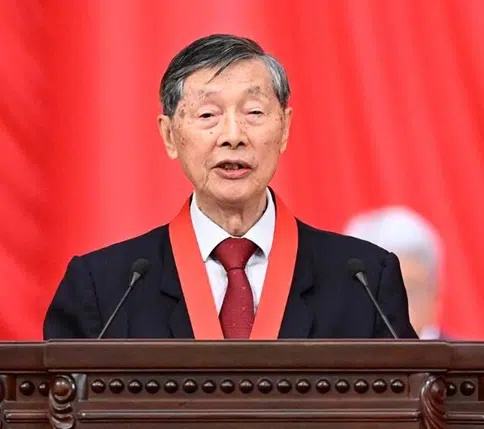
Pioneering scientist Chen Liquan has been honoured with a top national scientific award for his contributions to research and industrialisation of lithium ion battery tech.
Chen, described as the founding father of the country’s battery industry was presented with the State Preeminent Science and Technology Award for 2025 in Beijing on July 8, state news agency Xinhua announced.
Chen is a researcher at the Institute of Physics under the Chinese Academy of Sciences (CAS) and an academician of the Chinese Academy of Engineering (CAE).
He received the award at a meeting that brought together the national science and technology award conference, the general assemblies of the members of the CAS and the CAE, and the 11th national congress of the China Association for Science and Technology.
Born in 1940 in China’s Sichuan Province, Chen grew up with dim oil lamps and those early hardships fostered a visceral yearning for the convenience and brightness that electricity could bring, Xinhua said.
“It was not until his high-school entrance examination that he experienced electric lighting for the first time. It crystallised his aspiration — to devote his career to the power sector, so that more people could enjoy its light and convenience.”
As the global oil crisis of the 1970s exposed the vulnerability of energy systems, including China’s, Chen saw a need for a domestic solution to a country heavily dependent on imports.
In 1976, while on a research visit at the Max Planck Institute for Solid State Research in Germany, Chen identified the potential of lithium nitride for solid-state battery fabrication.
He realised that a small button cell had the potential to outstrip conventional battery chemistries such as lead acid, with the capacity to reshape transportation energy. Recognising this strategic frontier as vital to national energy security, Chen made a decisive pivot, Xinhua said.
Chen formally petitioned the CAS to abandon his established career in crystal materials research and venture into solid-state ionics — a field then completely uncharted in China.
In 1978, Chen formed a team that embarked on lithium battery research with, at that time, no relevant technology, specialised equipment or trained personnel in the country.
Chen and his team completed a one-year research plan in just five months and, in 1998, he went on to spearhead construction of China’s first pilot production line for lithium ion batteries based entirely on indigenous technology, equipment and raw materials.
“This milestone cracked the bottleneck of mass production and laid the cornerstone for industrial expansion,” Xinhua said.
He was the first in the world to propose an innovative solution for nano-silicon anode materials, and related materials realised mass production at a 10,000-tonne scale with world-leading performance.
Multiple core technologies developed under Chen’s leadership have since established a technical framework of self-reliance for China’s lithium battery sector.
He founded China’s first solid-state ionics laboratory, built academic exchange platforms and mentored a generation of top-level researchers and industry leaders.
Chen is also credited for paving the way for the success of battery giants, such as China’s CATL, by promoting an integration of academia and industry and helping to remove barriers to commercialisation.
Even as China maintains its global lead in liquid lithium batteries, Chen has continued to be active in tech development, including solid-state battery technology.
In 2023, high-energy-density solid-state power batteries incorporating this core technology entered mass production and has been installed in vehicles, making China the first country to achieve commercial deployment of solid-state batteries, and cementing its leading position on the global stage, Xinhua said.
Mindful of China’s resource endowment featuring abundant coal, scarce oil and limited natural gas, Chen has also taken a forward-looking stance regarding sodium-ion batteries, exploring alternatives that break resource constraints and open new avenues for diversified, independent energy development.
Chen said: “For a nation to move forward, we cannot simply replicate what others have done. We must have our own vision. Without fresh thinking, maintaining a leading edge is impossible.”
“The future goals are even greater,” he said.