
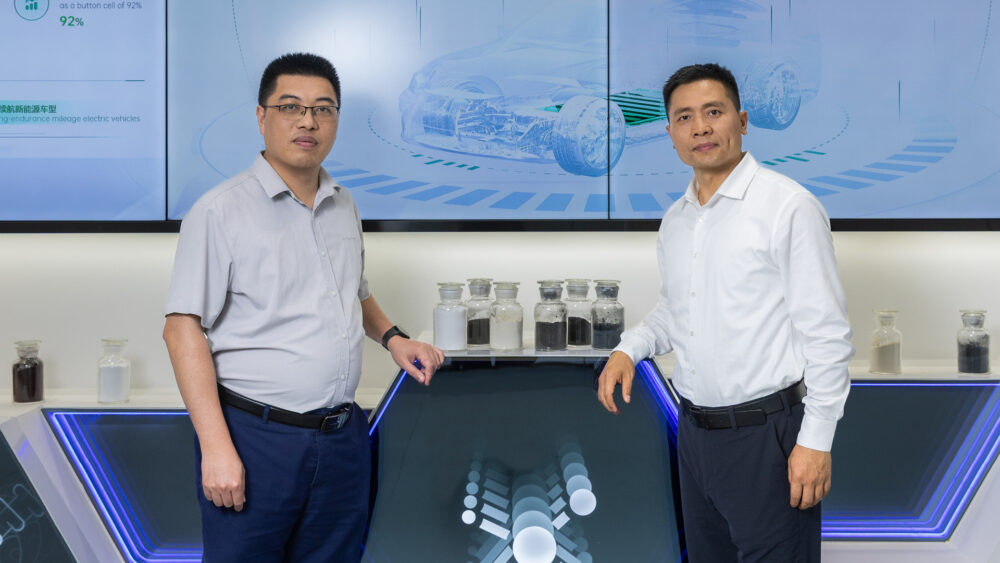
A Chinese research team dedicated to developing novel battery recycling tech has been named as one of the winners of an innovation award by the European Patent Office (EPO).
The team led by Yu Haijun and Xie Yinghao, from China’s Guangdong Brunp Recycling Technology, were among recipients of EPO’s 2026 European Inventor Award, announced on July 2.
The ‘popular prize’, determined by a combination of a public and jury vote, was also awarded to the team, which entered under a non-EPO country category.
According to EPO, the team’s ‘smart battery recycling’ technology is capable of regenerating high-quality cathode materials from spent lithium ion batteries.
The team said its ‘reverse-positioning’ method reuses the existing structure of the battery material’s core cells, including the aluminium element from the positive electrode, as a functional input rather than waste.
According to the researchers, the technology physically separates spent batteries to extract positive electrode tabs, which are then mixed with a special slagging agent and residual aluminium before undergoing a thermally initiated reaction. This produces a special nickel-cobalt-manganese alloy state, which is treated to create a porous structure powder. When combined with lithium and sintered, it becomes a high-grade cathode material.
The process is said to achieve near-complete metal recovery — 99.6% of nickel, cobalt and manganese and 96.5% of lithium. Acid and alkali use drops by 73% and the workflow is over 18% shorter than with traditional hydrometallurgy, enabling higher throughput and more practical ‘mega-industrial’ scaling.
Recycling nickel, cobalt and lithium emits about 80% fewer greenhouse gases than mining these materials, the team said. “With global EV battery installations exceeding 1,000 GWh and 190 GWh of scrap already accumulated, recovering materials from spent batteries can reduce the need for new mining.”
This year’s EPO awards ceremony, held in Berlin, honoured what the EPS said were groundbreaking advancements in the key fields of food chemistry, energy, biotech and environmental tech.
Photo: EPO