
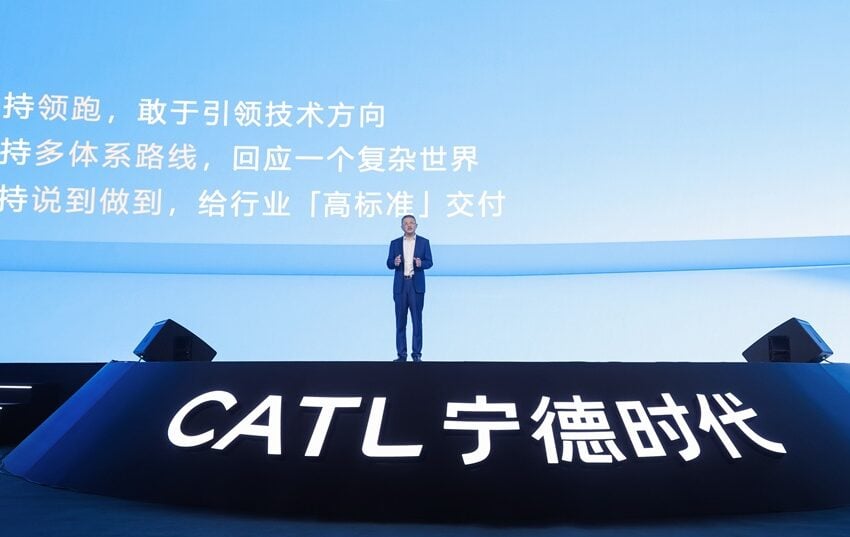
April 23, 2026: China’s CATL has rolled out its latest innovations in battery tech — showcasing fast-charging, high energy and heightened safety innovations to maintain global dominance of the EV battery market.
The launch came just weeks after CATL and Chinese auto firm Changan unveiled what the partners said was the first mass-production car equipped with sodium ion batteries.
Now CATL has used its April 21 ‘Super Technology Day’ in Beijing to highlight its third-generation Shenxing superfast charging battery, third-generation Qilin battery, Qilin condensed battery, second-generation Freevoy super hybrid, the Naxtra sodium ion battery and a fully integrated supercharging and battery swapping system.
The latest third-generation Shenxing
This has reached what is claimed to be the industry’s strongest capability — an equivalent 10C and a peak 15C charging rate. Charging from 10% to 35% SOC takes just one minute, with 10% to 98% SOC taking six minutes and 27 seconds.
Even at -30°C in extreme cold conditions, charging from 20% to 98% SOC takes about nine minutes.
The third-generation Qilin battery
This is designed for premium long-range EVs, achieving a cell energy density of 280Wh/kg and enabling 1,000km range while supporting 10C superfast charging.
Qilin delivers 3MW peak power, doubling the output of the second-generation Qilin track battery which competed on the Nürburgring (1,330kW). The entire battery pack weighs only 625kg. Compared with equivalent LFP systems, this represents a weight reduction of 255 kg and space savings of 112 litres.
Building on the national standard for NP (no thermal propagation), safety is strengthened through what CATL said is thermal-electrical separation, with each cell incorporating an independent sealed exhaust channel to isolate thermal events and prevent propagation, ensuring “heat takes the heat path, electricity takes the electrical path”.
Qilin condensed battery
This applies aviation-grade technology to passenger vehicles for the first time, achieving 350 Wh/kg cell energy density and 760 Wh/L volumetric energy density — setting a new record for mass-produced batteries. This enables 1,500 km range for sedans and over 1,000 km for large SUVs, with pack weight controlled within 650 kg.
The condensed battery features a high-nickel cathode and low-expansion silicon carbon anode, boosting energy density by 50Wh/kg.
According to CATL, the technology builds on the group’s electric aviation program, where 500Wh/kg systems are said to have completed maiden flight validation on four-tonne aircraft, with further validation underway on aircraft exceeding eight tonnes.
Replacing liquid electrolyte with a condensed system eliminates risks associated with leakage and combustion, CATL said.
Second-gen Freevoy Super Hybrid
This battery extends all-electric range to up to 600km and standardizes 10C superfast charging. The product integrates LFP and NCM materials through gradient-uniform mixing, with the olivine crystal structure of LFP serving as the core backbone, enabling a uniform hybrid of LFP and NCM materials at the powder particle level.
CATL said this achieves an energy density of 230Wh/kg and increases range by over 15% without increasing pack weight compared with single LFP systems.
Naxtra sodium ion battery
This marks the firm’s transition from laboratory breakthrough to large-scale manufacturing, CATL said. By systematically overcoming hundreds of engineering challenges, CATL has achieved GWh-level industrialisation.
CATL chief scientist Wu Kai summarized the strengths, limitations, and development of various material chemistries, noting that LFP is nearing its theoretical energy density limit — making it better suited for a technology roadmap centered on extreme fast charging to achieve optimal balance.
He said NCM’s high energy density keeps it at the forefront of global competition — underscoring that energy density remains the core metric for leadership.
On sodium ion, Wu said these batteries offer broad potential for extreme temperatures and energy storage applications.
And he said what the future needs of consumers, energy security and social development, the lithium battery industry must pursue coordinated development across multiple chemical systems.
CATL chairman and CEO Robin Zeng said “rigorous scientific spirit” is needed to drive innovation.
“For Chinese technology to go global, it relies not just on speed and scale, but on the quality of innovation, the ability to validate, and the credibility of the brand.”