
Germany’s Neptune Energy and Fraunhofer IEG have launched a fresh pilot phase to demonstrate they can extract lithium from deep water in the country — and play a potential future role in Europe’s EV battery materials supply chain.
Neptune said on August 13 it aims to extract lithium from thermal water — naturally heated groundwater enriched with minerals — at depths of 3,000-4000 metres, with an estimated resource of more than 40 million tonnes of lithium carbonate equivalent (LCE).
The energy company is working on the second pilot phase in the northern Altmark region, to test different adsorbent materials for future industrial use, following an evaluation of various technologies for direct lithium extraction (DLE).
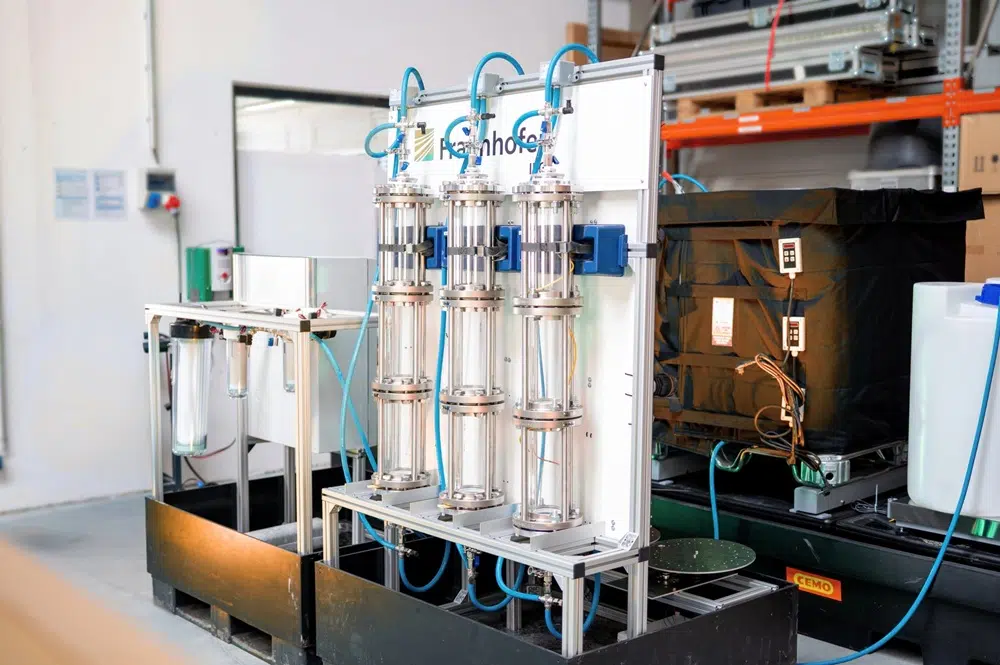
The pilot unit, developed in collaboration with Fraunhofer IEG, enables the extraction of lithium in an oxygen-free environment, with a processing capacity of up to 1,000 litres of thermal water per day.
Lithium is dissolved in brine at depths between 3,000-4,000 metres, Neptune said. This brine is found in the fine pore spaces of rock — from which the company plans to produce the brine via wells and extraction using DLE.
Now various adsorbent materials will be tested and evaluated over the coming months in a pilot unit for DLE developed in collaboration with Fraunhofer IEG.
Evonik Catalysts, which was selected to supply the adsorbent material for the first test phase, is supporting the pilot programme by providing on-site application and process expertise.
Adsorbents are designed to selectively adsorb (attract) lithium ions from the brine. The lithium is then desorbed (separated) from the adsorbent, producing a solution with a high lithium content — lithium chloride.
This can be processed in further steps to produce battery-grade lithium carbonate or lithium hydroxide monohydrate, which is the raw material for the European battery and electric mobility industry.
Joachim Sluet, midstream manager and head of pilot projects at Neptune Energy, said last year’s first pilot phase investigated various DLE technologies available to assess their suitability for the conditions in the Altmark region.
“Following tests using ion-exchange and adsorption processes, adsorption technology proved to be the most promising for the conditions in the region.”
Axel Wenke, director of new energy and business development, said: “This brings us another step closer to industrial-scale lithium production from the Altmark region.”
Photo: Neptune Energy