
An overhaul of planning rules for renewable energy projects in Greece has explicitly included battery storage systems for the first time.
The Greek government said the new national spatial planning framework, announced on August 19, was needed to increase protection for the country’s environment and cultural heritage — while also formally integrating battery storage in particular into the renewables planning process.
This means developers must comply with “spatial, environmental and regulatory criteria similar to renewable generation projects”, Greece’s environment and energy ministry said.
Restrictions on energy storage facilities include being a minimum of 500 metres from bathing beaches, world heritage sites and archaeological areas of major importance.
Energy storage and solar power facilities are also largely banned from high productivity agricultural land.
However, the framework stresses that the development of energy storage systems is necessary to support green transition goals.
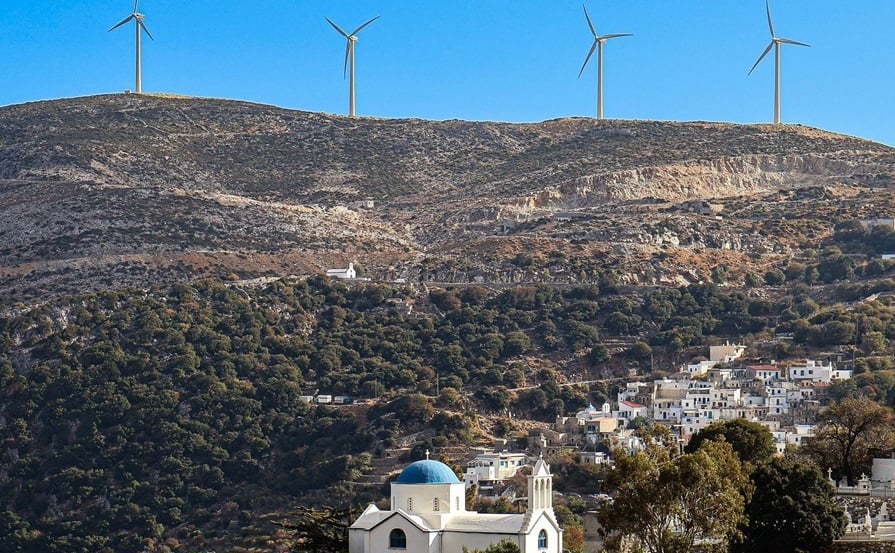
Under this guideline, new wind farms will be prohibited in certain areas of tourism. Exclusion zones have been expanded to include historical sites, ancient monuments and beaches.
The framework strengthens requirements on setting up wind farms on islands. Assessments of new projects must consider the scale of projects, the character of the landscape and visual impact.
New restrictions have also been introduced for islands with an area of less than 300km2, with certain exceptions such as for critical or public infrastructure.
New photovoltaic plants are now excluded from areas such as landscapes of special natural beauty and on bathing beaches.
The new rules supersede many of those in force since 2008 and follow public consultation. Renewables projects already in operation or at an advanced stage in the licensing process will continue to be governed by pre-existing rules.
Environment and energy minister Stavros Papastavrou said: “Greece has a significant advantage: the sun and the wind. Their utilisation for energy production is a strategic choice for our country. However, it requires a plan, rules and respect for space and the environment.”
Analysis published by the European Union earlier this year said Greece was among a broad group of EU member states showing “meaningful levels” of energy storage deployment — while plans for the rollout of much needed ESS capacity across Europe were uneven, fragmented and hindering investment.
Photo: Barbara Barbosa / Pexels