
The US arm of Germany’s Siemens group is to support the setting up of automated and digital manufacturing systems for New York battery prototyping and pilot production facility Battery-NY.
Battery-NY, an initiative backed by Binghamton University, said it aims to help develop domestic, advanced manufacturing of next-gen batteries for a variety of applications when it starts full operations in the coming months.
Siemens said on September 9 Battery-NY will build on its standardised automation and data architecture to take battery technologies from the drawing board to real-world battery manufacturing.
Materials, cell designs and process concepts can be evaluated at the facility using manufacturing-relevant equipment, repeatable workflows and consistent production data — helping teams understand what is required to scale beyond the laboratory.
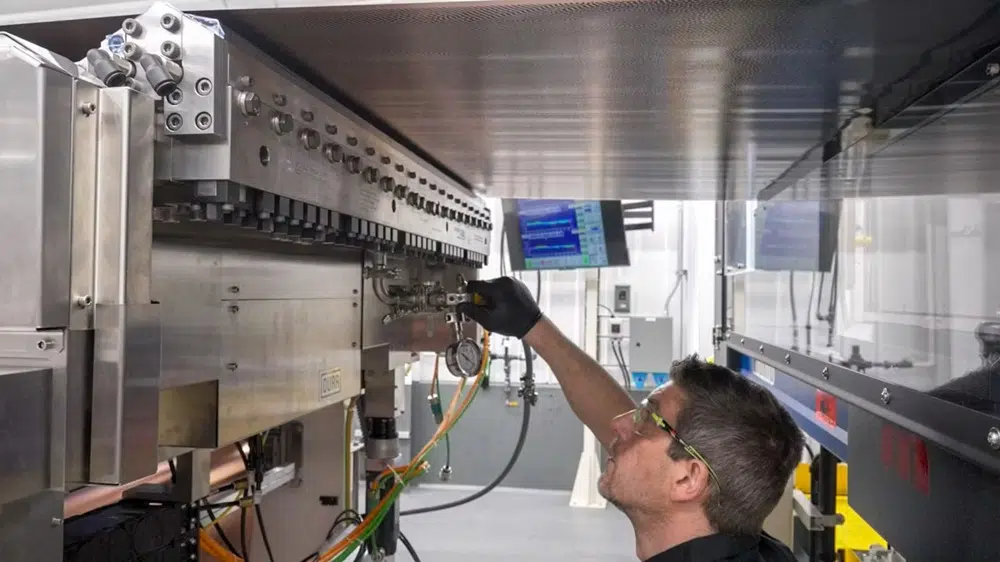
Battery-NY has adopted Siemens automation across much of its principal production-equipment and is using the Siemens Battery Automation Framework as a standardisation reference.
Specialised battery manufacturing equipment often comes with disparate control and data systems, leading to fragmented information and costly custom integrations, Siemens said.
Battery-NY and Siemens are tackling this through a common operational framework across critical processes, including mixing, coating, calendering, slitting, cell assembly, formation and cycling.
The facility will have the ability to actively track real-time data resulting from battery production processes, from the humidity levels of dry rooms to the amount of vibration produced by equipment. Each Battery-NY-produced cell will have a ‘digital passport’ that details this information to streamline production and transparency.
Paul Malliband, executive director of Battery-NY, said: “We started working with Siemens early because we wanted to consider digitalisation from the beginning, not add it after the equipment was installed.
“Our goal is a flexible, modular facility where new battery technologies and manufacturing approaches can be introduced over time while the controls, automation and software foundation evolve with them.”
Binghamton University is a public research university in the State University of New York (SUNY) system. Binghamton is home to Stanley Whittingham, the Nobel Prize-winning scientist whose work was foundational to the development of the lithium-ion battery.
The university is also leading New Energy New York (NENY), a major battery-technology and manufacturing initiative backed by more than $113 million in federal and New York State funding.
Photo: Siemens