

India’s leading battery manufacturers have called for a fundamental shift in industrial strategy, warning that competing with China’s dominance will require decades of sustained investment, stronger government policy and the development of an entire battery manufacturing ecosystem.
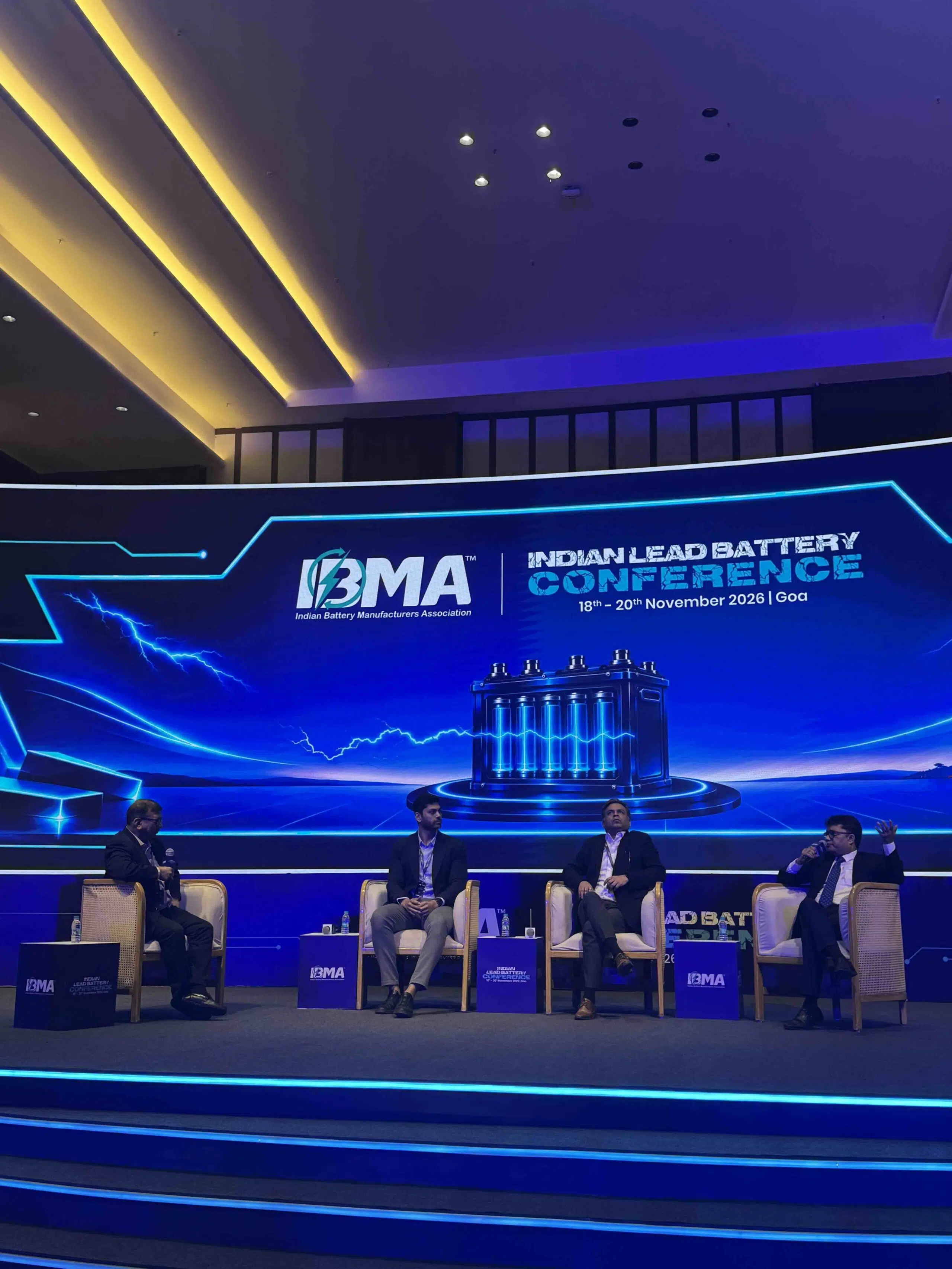
Speaking at the inaugural Indian Lead Battery Conference (ILBC) in Goa on November 19, senior executives from Exide Industries, Amara Raja Energy & Mobility and Luminous Power Technologies offered contrasting assessments of India’s prospects, but agreed that innovation, collaboration and long-term planning would be critical to the industry’s future growth.
The discussion, chaired by ILBC chairman Dr Dipak Sen Chaudhuri, followed a question from Batteries International about the single biggest obstacle preventing India from overtaking China as a global leader in lead battery manufacturing.
Vivek Abrol, CEO of Luminous Power Technologies, argued that China’s success had been built not simply on manufacturing capacity, but on developing entire industrial ecosystems supported by coordinated government policy, technology investment and export infrastructure.
“What fascinates me is how they look at the entire ecosystem together,” he told delegates.
Pointing to China’s solar and electric vehicle industries, Abrol said the country had developed equipment, processes, technology, government frameworks and export strategies in parallel, creating the conditions for rapid industrial expansion.
“They are not just developing a particular industry per se,” he said, emphasising China’s ability to plan 10 or 20 years ahead while simultaneously developing supply and demand.
Harsha Gourineni, executive director of Amara Raja Energy & Mobility, agreed that long-term strategic thinking was essential, warning that India’s tendency to operate within five or ten-year planning horizons could undermine its ambitions.
He pointed to China’s ability to establish a 20 to 30-year industrial vision and pursue it consistently, allowing the necessary supply chains, manufacturing capabilities and technical expertise to develop over time.
Such industrial transformation, he argued, could not happen overnight.
Gourineni also called for greater collaboration across the battery industry, particularly in research, materials development, digital simulation and manufacturing processes.
Rather than regarding competing battery chemistries solely as threats, he urged lead battery manufacturers to concentrate on applications where their technology could continue to deliver competitive advantages, including starting, lighting and ignition batteries, residential energy storage and industrial uninterruptible power supplies.
“It’s not too late. Definitely not too late,” he said.
“If we can come together as an industry, whether it’s here in India or globally, there’s a lot we can do.”
Avik Roy, managing director and CEO of Exide Industries and president of the Indian Battery Manufacturers Association, offered a different perspective on India’s competitive position.
Rather than focusing on matching China’s absolute manufacturing scale, he argued that India’s enormous untapped domestic market provided sufficient opportunity to sustain substantial growth across multiple battery technologies.
Roy pointed to the disparity in passenger vehicle ownership between India and China, citing approximately 35 cars per 1,000 people in India compared with 350 in China.
Even Indonesia, at approximately 100 cars per 1,000 people, offered a more immediate benchmark for India’s automotive ambitions, he suggested.
With vehicle ownership expected to rise alongside improvements in roads and infrastructure, Roy said the resulting growth in the vehicle population would create substantial opportunities for original equipment manufacturers and the replacement battery market.
He argued that no single battery chemistry would be capable of meeting the requirements of India’s diverse and expanding automotive sector.
But Roy also delivered one of the panel’s most striking observations about the lead battery industry’s failure to innovate more aggressively.
For years, he said, predictions of lead-acid technology’s imminent demise had discouraged manufacturers from committing sufficient resources to research and development.
The industry had not necessarily become complacent, he suggested. Instead, it had accepted premature predictions that its technology was approaching obsolescence.
“We lost hope too early,” he said.
Roy questioned whether lithium-ion technology itself could be assured of long-term dominance, given the pace at which alternative chemistries were emerging.
He said manufacturers needed to recognise that future competition might look very different from today’s battle between lead-acid and lithium-ion batteries.
The discussion also turned to the role of government policy in supporting India’s ambitions.
Asked by Batteries International which single policy change would make the greatest difference to the country’s battery industry, Gourineni called for a more integrated approach to circularity, particularly closer alignment between battery manufacturing and recycling.
He argued that while India had made progress in recognising the importance of sustainability, policy had not yet fully translated that ambition into an integrated framework.
Greater formalisation of manufacturing and recycling, he suggested, would enable the industry to recover and reuse materials more efficiently and safely while strengthening domestic supply chains.
The issue was not simply one of technological breakthroughs, he said, but of cooperation between manufacturers, recyclers and other stakeholders.
His comments reinforced a broader theme running throughout the discussion: India’s ambitions will depend as much on the development of supporting industries, infrastructure and regulatory frameworks as on investment by battery manufacturers themselves.
With India’s domestic demand continuing to expand and the global energy storage market undergoing rapid technological change, the three executives painted a broadly optimistic picture of the industry’s prospects.
But their underlying message was clear. India’s opportunity is substantial, yet turning that potential into global industrial leadership will require a coordinated strategy extending far beyond the factory gates.