

July 5, 2018: India’s largest lead battery maker, Exide Industries, signed a joint venture with the Swiss lithium ion battery maker Leclanché on June 28 in a move that will add the battery chemistry to the Indian firm’s portfolio.
The JV, which will be 75% under Exide’s control, will enable lithium cells, modules and battery packs to be manufactured in the state of Gujarat by the second quarter of 2019. A Li-ion cell production plant will begin operating mid 2020, the firms said.
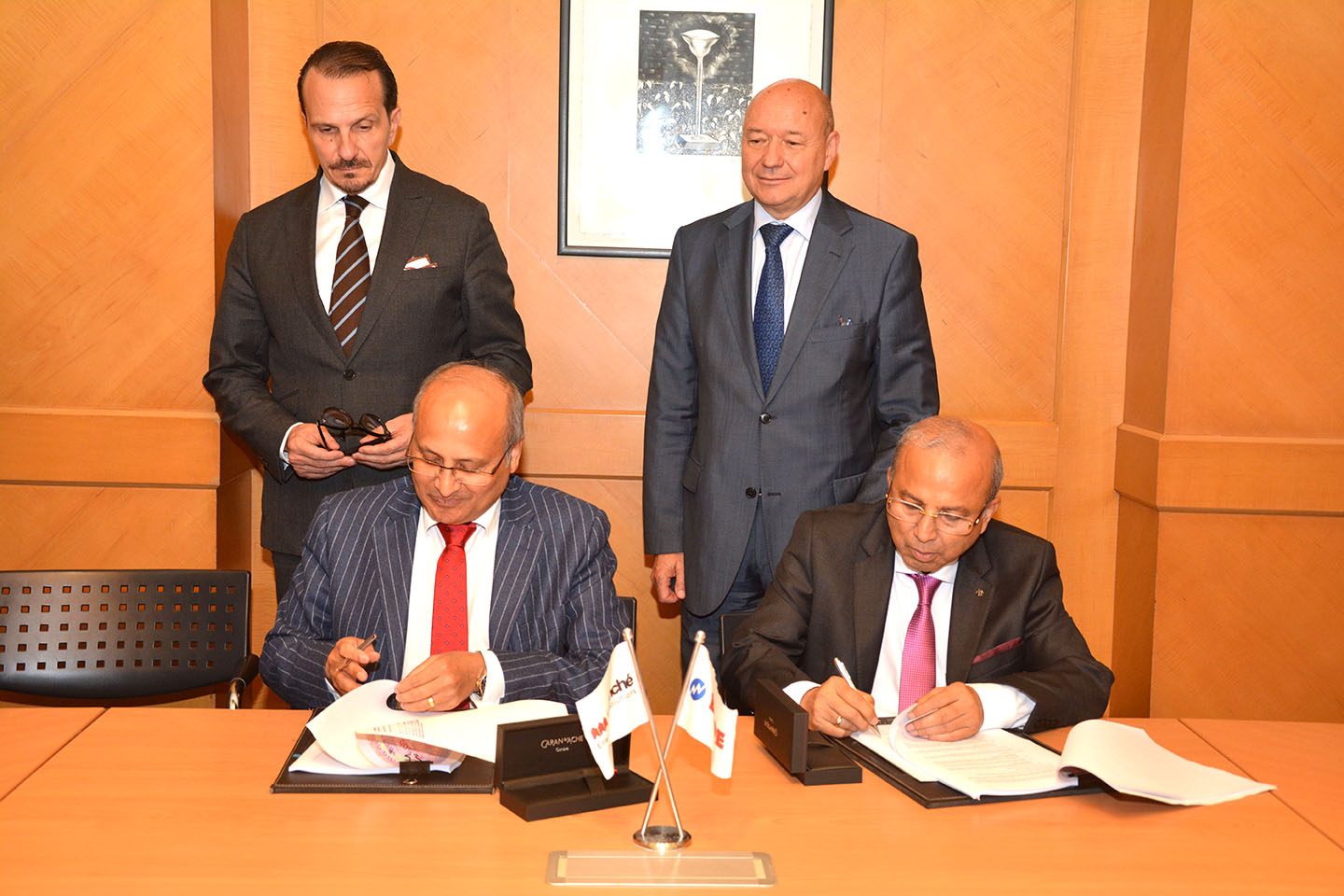
Gautam Chatterjee, managing director and CEO of Exide Industries (pictured signing, right) said the firm was responding to Indian government policies.
“Since the government is focusing on the electric vehicle industry we thought to stay relevant we should go into this,” he told BESB.
“We were looking for a company to help develop this and chose Leclanché to work with. Initially it will be limited to buses and two and three wheelers, but gradually this will expand and include all kinds of cars.
“The JV will focus on e-transport, stationary energy storage systems and speciality storage markets. In e-transport, the target segment is fleet vehicles including e-buses, e-wheelers and e-rickshaws.”
The JV will also provide energy storage systems for India’s EV market and grid-based applications.
“This ideally complements our leading position in the lead acid storage battery market in India and will allow us to take the lead in the lithium-ion battery industry, which is expected to grow significantly in the next few years,” said Chatterjee.
Leclanché CEO Anil Srivastava (pictured signing, left) said India was expected to be one of the world’s largest and fastest growing markets for EVs.
“The JV will provide Leclanché with giga-scale procurement volumes, which will help reduce costs and increase recurring annuity revenues, generating recurring stable revenue growth for the company,” he said.
India is the fifth largest car market in the world, and is expected to enter the top three in the very near future, with 600 million vehicles likely to hit the streets by 2030 — some 40% of these are likely to be electric, according to some analysts.
* Separately, at the end of June, Exide signed an agreement to buy a closed-down factory belonging to lead acid battery manufacturer Tudor India, the Indian arm of the US company Exide Technologies.
Last May, the Indian firm settled an argument with Exide Technologies over the use of the Exide trademark in India. After 19 years of legal battles, the US firm finally gave up its claim to the trademark — and the sale of the factory marks the end of Exide’s production in India.
Exide Technologies director of corporate communications Melissa Floyd told BESB: “Exide Technologies has been in the process of winding down its manufacturing operations in India for some time. The sale of assets in India is a result of the company’s decision to cease direct production in India.”