

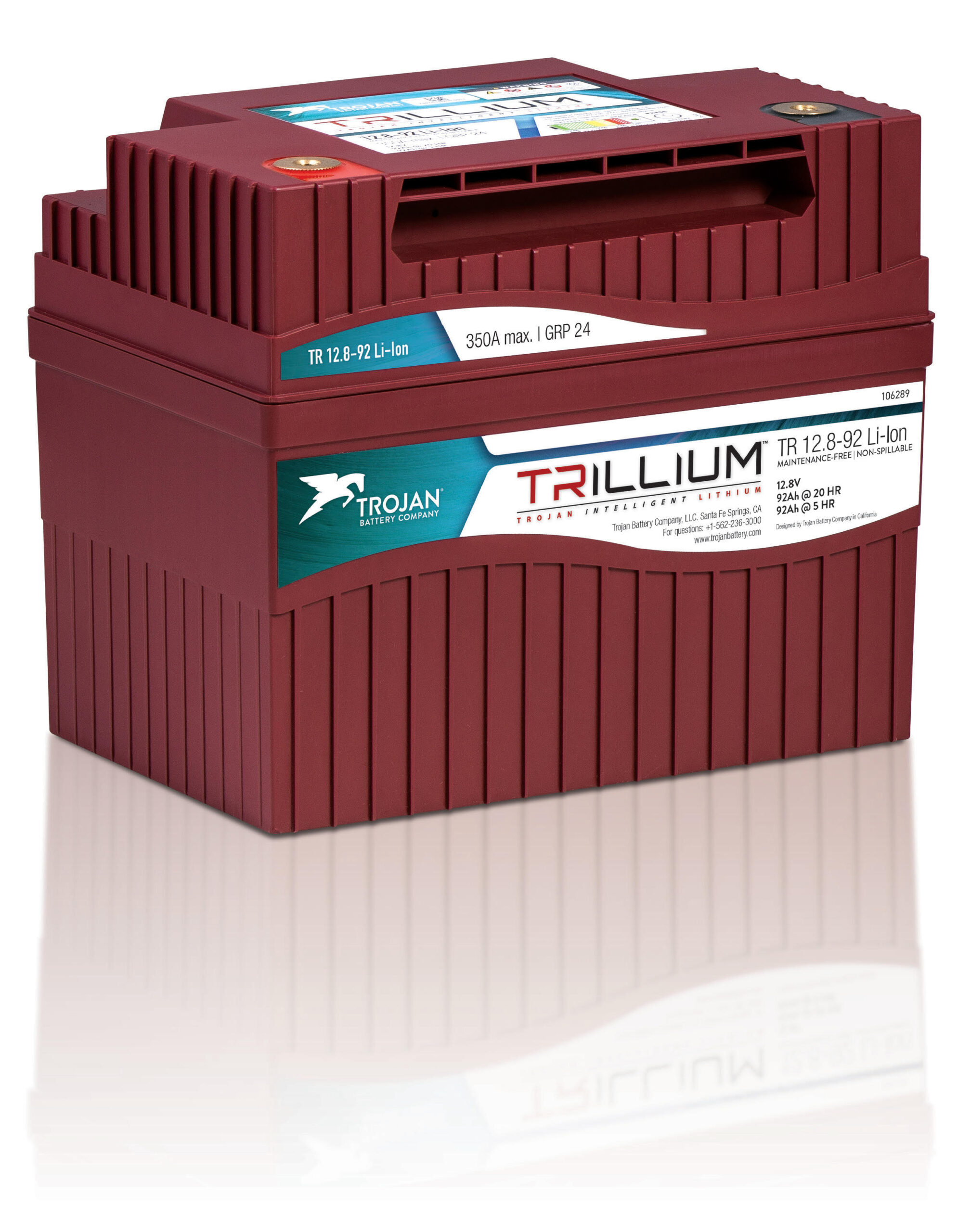
November 8, 2018: Trojan Battery, the deep cycle lead battery maker, revealed its first line of lithium batteries on October 29, which the company says can replace lead batteries in existing applications and use the same charging equipment.
The company says its Trillium — it stands for Trojan Intelligent Lithium —batteries have a better run time, life cycle and safety rate than any other lithium equivalent on the market.
They could replace lead batteries in some of Trojan’s core markets — such as floor-cleaning machines, aerial work platforms, golf carts and utility vehicles — director of global product solutions Ivan Menjak told BESB.
“We are definitely late to the lithium party — we may not be the first, but we want to make sure we are the best,” he said.
“It’s a very small part of the market share right now but as we look to the future we see growth in that area and we want to be able to position ourselves to offer all solutions.
“It’s not that we want to replace or displace lead, that’s not the idea. We’re not competing against it and we don’t see it as hurting the lead business, in fact it will help it overall. We’ve seen it already with some customers who can see we are now able to supply multiple solutions.”
Menjak said that while cost was still the primary driver behind a lot of customers selecting lead batteries, in some cases it wouldn’t make sense to buy a longer lasting lithium battery anyway.
With fleet golf carts — which are leased by golf clubs for an average of four years before they are sold in the secondary market — it would be difficult to justify buying the more expensive battery, he said.
“At the moment, lead is a fifth of the cost of lithium,” he said. “If the prices continue to come down, we will see more of a move to lithium. It’s coming down every year and we will see that in the next five years, lithium will be in the area of 5%-10% of the market share in our core markets. This isn’t huge — but it’s not insignificant either.”
Menjak said the company had been working with a partner to develop the batteries under a joint development agreement, with Trojan driving the development using the partner’s technical skills.
Many of the larger lead battery companies now also produce lithium batteries.
In April, Exide Technologies launched its LiFTFORCE LPX battery on the US market, although they had been launched on the European market in 2013.
In 2016, East Penn decided to move into lithium ion, confirming the company had a dedicated group of engineers working on the technology.
The world’s largest battery manufacturer, Johnson Controls, has been making lithium batteries for some years.