

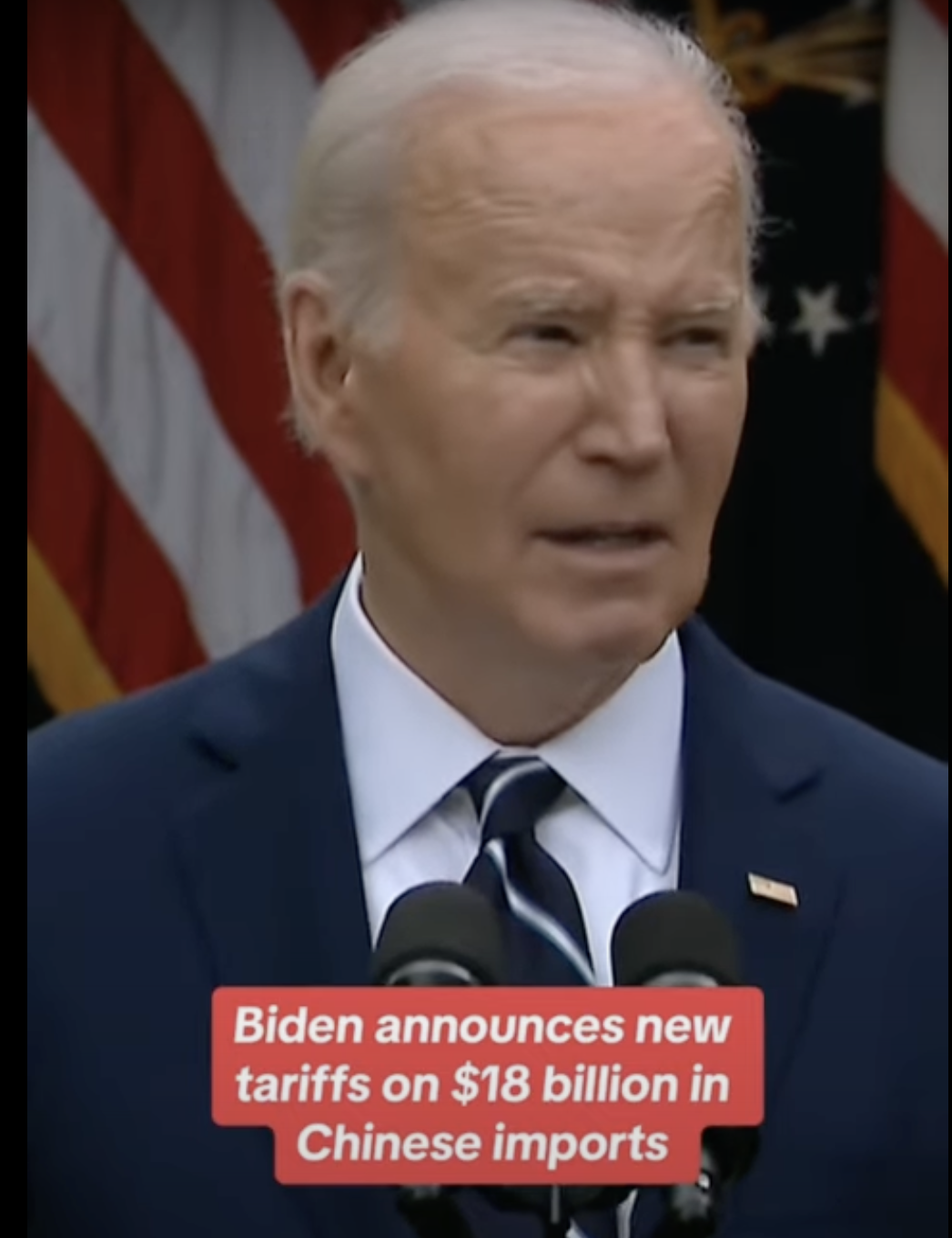
May 17, 2024: US president, Biden, dealt another blow in the escalating trade dispute between the country and China on May 14.
A White House spokesperson said: “China’s unfair trade practices concerning technology transfer, intellectual property, and innovation are threatening American businesses and workers. China is flooding global markets with artificially low-priced exports.
“In response to China’s unfair trade practices and to counteract the resulting harms, president Biden is directing his trade representative to increase tariffs under Section 301 of the Trade Act of 1974 on $18 billion of imports from China to protect American workers and businesses.”
The moves by the US need to be put into the larger context of growing pressures on cross-border trade worldwide.
A recent IMF study shows that restriction on tariffs are just part of a larger picture where there has been a tit-for-tat escalation on subsidies. The paper says there is a 74% probability that a subsidy for a given product in a big economy is met with a subsidy for the same product from another big economy within a year.
Protectionism is also on the increase.
According to international law firm White & Case, the Committee on Foreign Investment in the United States inspected 286 deals in 2022 for their implications to the detriment of US interests against 97 a decade before.
A similar situation exists in other regions. The EU, although supposedly more supportive of free trade and more determined to reduce its greenhouse gas emissions than other economic powers, is on the verge of imposing duties on Chinese-made EVs. The UK is in a very similar position.
The latest US tariffs are targeted at what the Biden administration terms “strategic sectors”.
Specifically, these are high-tech areas in the automotive and energy industries where the government has thrown a wall of money through the Investing in America agenda and the 2022 initiative known as IRA, the Inflation Reduction Act as well as the Bipartisan Infrastructure Law and the CHIPS and Science Act.
The US government says this has already made more than $860 billion in business investments through public incentives in future industries such as EVs, clean energy, and semiconductors. This, it says, has created 800,000 manufacturing jobs and new factory construction has doubled.
Biden said: “China’s government has used unfair, non-market practices. Its forced technology transfers and intellectual property theft have contributed to its control of up to and even 90% of global production for the critical inputs necessary for our technologies, infrastructure, energy, and health care — creating unacceptable risks to America’s supply chains and economic security.”
China’s ministry of commerce claimed that these were unfair saying that “China will take resolute measures to defend its rights and interests.”
If proportionate, China’s measures would penalize roughly $6.2 billion of its $148 billion in US imports.
From the US, the tariff rate on electric vehicles under Section 301 will increase from 25% to 100% in 2024.
“With extensive subsidies and non-market practices leading to substantial risks of overcapacity, China’s exports of EVs grew by 70% from 2022 to 2023 — jeopardizing productive investments elsewhere, said a US government statement. “A 100% tariff rate on EVs will protect American manufacturers from China’s unfair trade practices.
“This action advances president Biden’s vision of ensuring the future of the auto industry will be made in America by American workers. “We are incentivizing the development of a robust EV market through business tax credits for manufacturing of batteries and production of critical minerals, consumer tax credits for EV adoption, smart standards, federal investments in EV charging infrastructure, and grants to supply EV and battery manufacturing.
“The increase in the tariff rate on electric vehicles will protect these investments and jobs from unfairly priced Chinese imports.”
The tariff rate on lithium-ion EV batteries will increase from 7.5% to 25% in 2024, while the tariff rate on lithium-ion non-EV batteries will increase from 7.5% to 25% in 2026. The tariff rate on battery parts will increase from 7.5% to 25% in 2024. The rate on natural graphite and permanent magnets will increase from zero to 25% in 2026. The tariff rate for certain other critical minerals will increase from zero to 25% in 2024.
“Despite rapid and recent progress in US onshoring, China controls over 80% of certain segments of the EV battery supply chain, particularly upstream nodes such as critical minerals mining, processing, and refining,” noted a White House statement. “Concentration of critical minerals mining and refining capacity in China leaves our supply chains vulnerable and our national security and clean energy goals at risk.
“To improve US and global resiliency in these supply chains, president Biden has invested across the US battery supply chain to build a sufficient domestic industrial base. Through the Bipartisan Infrastructure Law, the Defense Production Act, and the Inflation Reduction Act, the Biden-Harris Administration has invested nearly $20 billion in grants and loans to expand domestic production capacity of advanced batteries and battery materials.”
Other tariff hikes include: the rate on solar cells (whether or not assembled into modules) increasing from 25% to 50% in 2024 and on semiconductors from 25% to 50% by 2025.
The dispute has been brewing for some time. In July 2018, former US president Donald Trump imposed sweeping tariffs on China for its alleged unfair trade practices. Over the months that followed, the two countries took part in countless negotiations on foreign technology restrictions and fought several WTO cases, consequently leading US-China trade tensions to the brink of a full-blown trade war.
By 2020 the US had slapped tariffs on $550 billion worth of Chinese products. China had set tariffs on $185 billion of US goods.
With the advent of the Biden administration that year negotiations over the tariffs began again, but during 2023, the row over China’s alleged subsidies and covert protectionism and dumping has raised its ugly head again.