

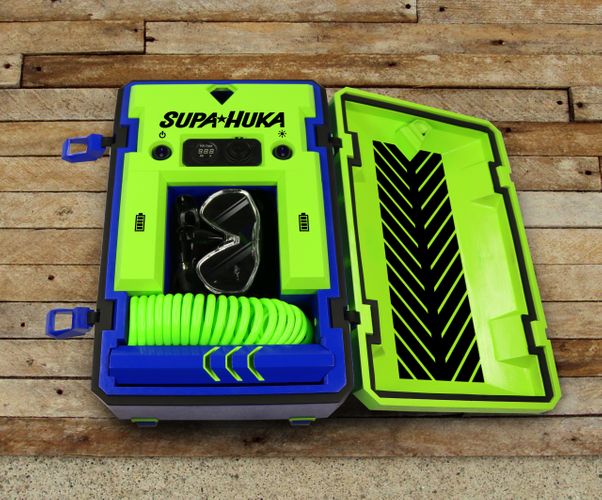
June 21, 2018: Supa Huka, a start-up company in Canada, has selected lead batteries to power the air pump in its brand new diving system, which allows swimmers to plunge to depths of 12 metres and stay there for two hours without an oxygen tank.
The Supa Huka diving system was the brainchild of mechanical engineer Michael Rushe, who sketched out the idea on the plane back from a family holiday in Hawaii.
“I was diving while my sons were snorkelling and later that day I realized that it was a lot of work for them to keep going up and down with their snorkels and it was impossible for them to get down to the reefs and see all the fish,” he said.
“The best of the ocean life is toward the bottom and if you are snorkelling and not diving it takes a lot of effort.
“I came out of it thinking about a hybrid, something between diving and snorkelling, and I came up with the Supa Huka.”
Designed to be the size and shape of a carry-on piece of flight luggage and with wheels and a telescope handle to boot, the Supa Huka, complete with 300W lead-acid battery, is attached to the swimmer with a coiled hose and floats on the surface of the water.
The hose can extend to a maximum of 12 metres (the limit for safe diving without having to go through decompression on ascension), although most swimmers would remain at depths of around seven metres, said Rushe.
The battery powers the air compressor, which lasts for two hours. Should there be any problem, there is a back-up store of spare air on the diver’s vest and all sorts of safety features, such as battery gauges and moisture sensors, to keep the swimmer safe.
“We consulted a company here in Canada to decide which battery to use and decided on lead for many reasons, safety being the most important — we didn’t want anything that could catch fire.
“The other reason was airline restrictions on luggage — you can take twice the weight of lead battery as you can lithium.
“We worked out that a lead battery has 105lbs of water displacement, and the total system has a weight of 22 kilograms.”
Supa Huka has made two prototypes of the system. Funding the start-up came from the sale of a company that Rushe previously owned.
Five former members of staff have joined him on his new venture, and with crowd funding he is hoping to make and start shipping the Supa Huka systems by August.
They will retail at around $600.