
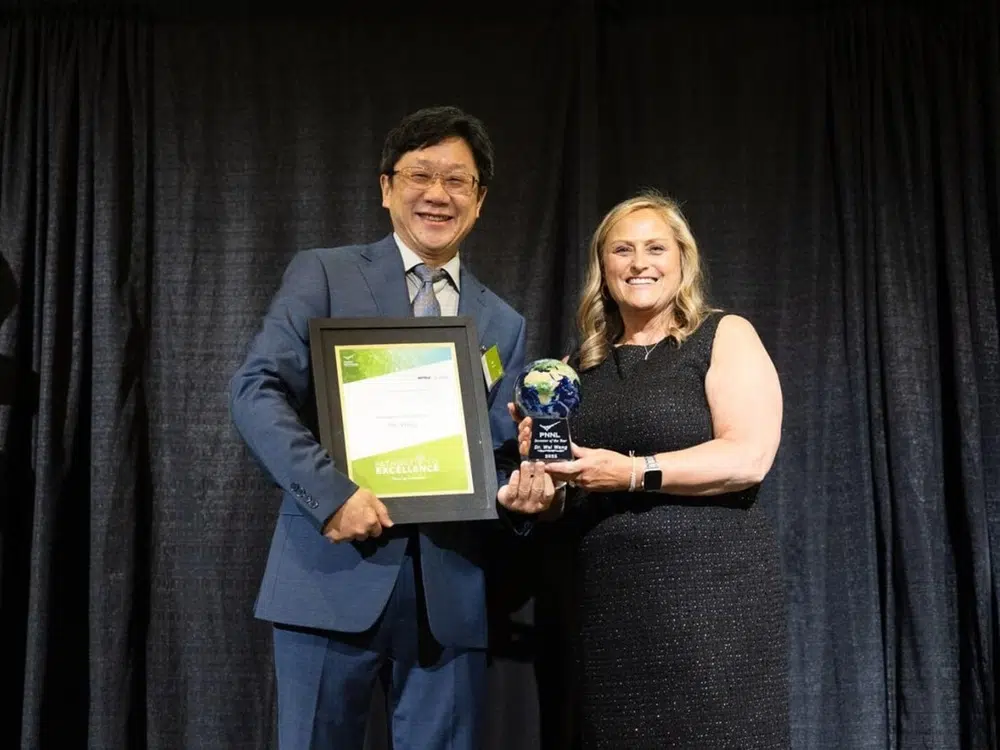
Laboratory Fellow and materials scientist Wei Wang has been named 2025 Pacific Northwest National Laboratory (PNNL) Inventor of the Year.
PNNL announced on July 21 that Wang had been awarded one of the lab’s highest recognitions for innovation and technology commercialisation — his inventions having helped transform grid energy storage from a niche research topic into technologies that are manufactured and deployed commercially.
Presented as part of PNNL’s Pathway to Excellence awards in June, the honour recognises researchers who have a significant all-time body of work and outstanding contributions to an extensive intellectual property portfolio that has led to commercial engagement and impact.
PNNL said Wang’s contributions to energy storage had led him to join a select group of 21 previous recipients in the lab’s history to receive the distinction.
Wang is a nationally recognised scientist who serves as the deputy director for the Energy Storage Research Alliance, is a technical lead for stationary energy storage R&D and previously directed PNNL’s Energy Storage Materials Initiative from 2019 to 2024.
His pioneering contributions to redox flow batteries and electrolyte solvation chemistry have earned numerous honours from the American Chemical Society, The Electrochemical Society, the US Environmental Protection Agency, the Federal Laboratory Consortium and R&D 100.
Beyond niche
As a Battelle Distinguished Inventor, Wang holds more than 20 patents with multiple licences and has authored more than 80 scientific publications, resulting in being named a Clarivate Highly Cited Researcher.
For Wang, the recognition is especially meaningful because it reflects the growth of a field that was once considered highly niche.
He said: “I think we are in a time where energy storage has become an important, popular topic but is still an emerging technology type. To receive this award and understand that PNNL is recognising the work in this new emerging area is exciting and encouraging.”
Bill Pike, deputy director for science and technology at PNNL, said: “Wei recognised the potential of energy storage long before it became a major national priority and helped establish the capabilities, collaborations, and research directions that have made PNNL a leader in the field. His career demonstrates how scientific vision, sustained over time, can transform an emerging area of research into a strategic strength for the Laboratory and the nation.”
Wang co-founded the International Coalition for Energy Storage and has encouraged early-career researchers to pursue new ideas.
“I encourage junior scientists to be really bold in their ideas and research directions,” he said. “If you sense the need to start in a new research direction, don’t be afraid to explore those different ideas or pathways.”
ESS transformation
While pursuing his doctorate in materials science and engineering at Carnegie Mellon University (CMU), Wang connected with Daiwon Choi, a fellow CMU alumnus who had recently joined PNNL.
At the time, battery energy storage research at PNNL was limited, so Choi encouraged him to apply. PNNL hired Wang before he completed his degree, allowing him to finish his final year before joining the laboratory full time.
When Wang arrived at PNNL, battery research received modest support from the Department of Energy’s Office of Electricity. As the US grid grew more complex and electricity needs increased, reliable long-duration energy storage became increasingly important for maintaining a secure and reliable electric grid. This growing national need transformed energy storage from a specialised research topic into a strategic priority.
Although trained in lithium-ion batteries, Wang quickly expanded into multiple electrochemical energy storage technologies, laying foundation for his later work in redox flow batteries.
That work led to an R&D 100 Award for developing a nanocomposite material that greatly improves the performance of lithium ion batteries.
Redox flow potential
Christina Lomasney-Mattis, chief commercialisation officer at PNNL, said: “His inventions have generated valuable intellectual property, attracted commercial partners, and helped accelerate the deployment of technologies that support a more resilient energy future. His career is a powerful example of how sustained scientific excellence, combined with a commitment to technology transfer, can create lasting national impact.”
Soon after, Wang began working on redox flow batteries, which offer promising potential for grid-scale energy storage.
Working with flow battery systems, Wang and his team tackled one of the technology’s most persistent challenges: electrolyte instability at extreme temperatures. These conditions can cause solid deposits to form, reducing battery performance and lifespan.
The team discovered that carefully controlling how ions interact with surrounding solvent molecules — known as solvation chemistry — could dramatically improve electrolyte stability, preventing damaging reactions and significantly improving battery stability.
The resulting technology was licensed for commercial development, helping translate PNNL’s fundamental advances in electrolyte chemistry into practical solutions for long-duration, grid-scale energy storage.
The success attracted growing support from multiple partners, allowing the programme to expand into long-duration energy storage, battery manufacturing and scale-up, materials development, diagnostics, and commercial demonstration projects. The work laid the foundation for PNNL’s growth into one of the world’s leading research and development centres for grid energy storage.
Accelerating discovery
In 2017, Wang championed a new vision for energy storage materials discovery — integrating robotics, artificial intelligence, high-throughput experimentation, theory, computation, and digital twins to accelerate the discovery and development of next-generation materials.
Recognising the growing importance of energy storage, PNNL leadership asked Wang to help shape the future of the field at PNNL. Working with scientists, engineers, and researchers from multiple disciplines, he spent two years developing the Energy Storage Materials Initiative (ESMI), a five-year strategic investment to develop new scientific approaches that accelerate energy storage research and development.
From 2019 to 2024, Wang served as ESMI’s director, helping develop workflows and frameworks that combine new capabilities that use AI, automation, and robotics to evaluate materials and guide experiments more efficiently. The initiative created PNNL’s Materials Innovation through Robotics and AI Laboratory (MIRAL) as a nationally recognised capability for AI- and robotics-enabled materials discovery, located within the Grid Storage Launchpad.
Beyond building new research capabilities, Wang has also contributed to broader DOE efforts through a detailed assignment with the Advanced Materials and Manufacturing Technologies Office, helping strengthen connections between energy storage research and advanced manufacturing.
Ruozhu Feng, a seedling project leader for ESMI, said: “Through ESMI, he has created space for us to explore new ideas, develop emerging concepts, and build confidence as independent scientific leaders.”
Despite his many accomplishments, Wang credits collaboration and a willingness to pursue uncertain ideas as the foundation for innovation.
He said: “Einstein asked, ‘If we knew what we were doing, it wouldn’t be called research, would it? Most of the time we don’t know what we’re doing, but what I find rewarding is the colliding of different ideas on this team. That is the spark that leads us towards a better understanding of what we’re trying to do.”
Photo: Eddie Pablo / PNNL