
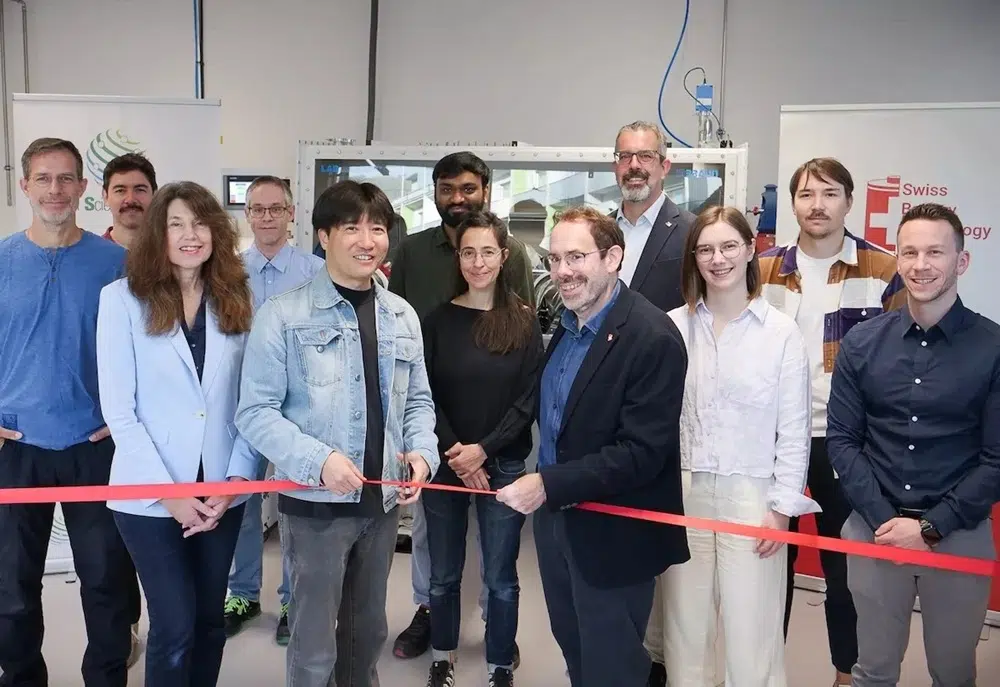
Japanese chemical and green tech company Green Science Alliance has opened a laboratory dedicated to next-generation battery recycling in Switzerland.
The lab, opened on October 19 at the Switzerland Innovation Park Biel/Bienne, operates in partnership with the Swiss Battery Technology Center.
Work at the innovation park includes assessing regenerated materials, making electrodes and cells, testing performance, and evaluating industrial potential and scalability.
GSA-developed materials for a more sustainable society include biomass-based alternatives to petroleum-derived products to rechargeable batteries, fuel cells and solar cells.
GSA said it chose the Swiss site as its base for expanding in Europe and plans further collaborative R&D. The company aims to commercialise its technology in Europe with the help of the innovation park’s network of industrial partners, start-ups and research institutions across the battery value chain.
If scaled up, the method could reduce the resources needed for recycling, lessen reliance on newly mined raw materials and support more resilient European battery supply chains, GSA said.
Mechanically processing used lithium ion batteries produces a dark powder called black mass, which contains valuable electrode materials. Conventional recycling dissolves it with acids or bases to recover individual metals, which then need several more processing steps before reuse.
GSA said its approach is to directly regenerate the cathode active materials so that they can go back into new batteries, without fully breaking them down into elements. This could cut recycling steps and resource use.
Early results show that batteries made with regenerated cathode materials reached over 90% of the initial capacity of comparable batteries using commercial materials.
The technology is being developed for both NMC and LFP batteries, GSA said.