Written by: John Shepherd

Advertisement
Unlock premium reporting and in-depth coverage
Subscribe
Advertisement
Written by: John Shepherd
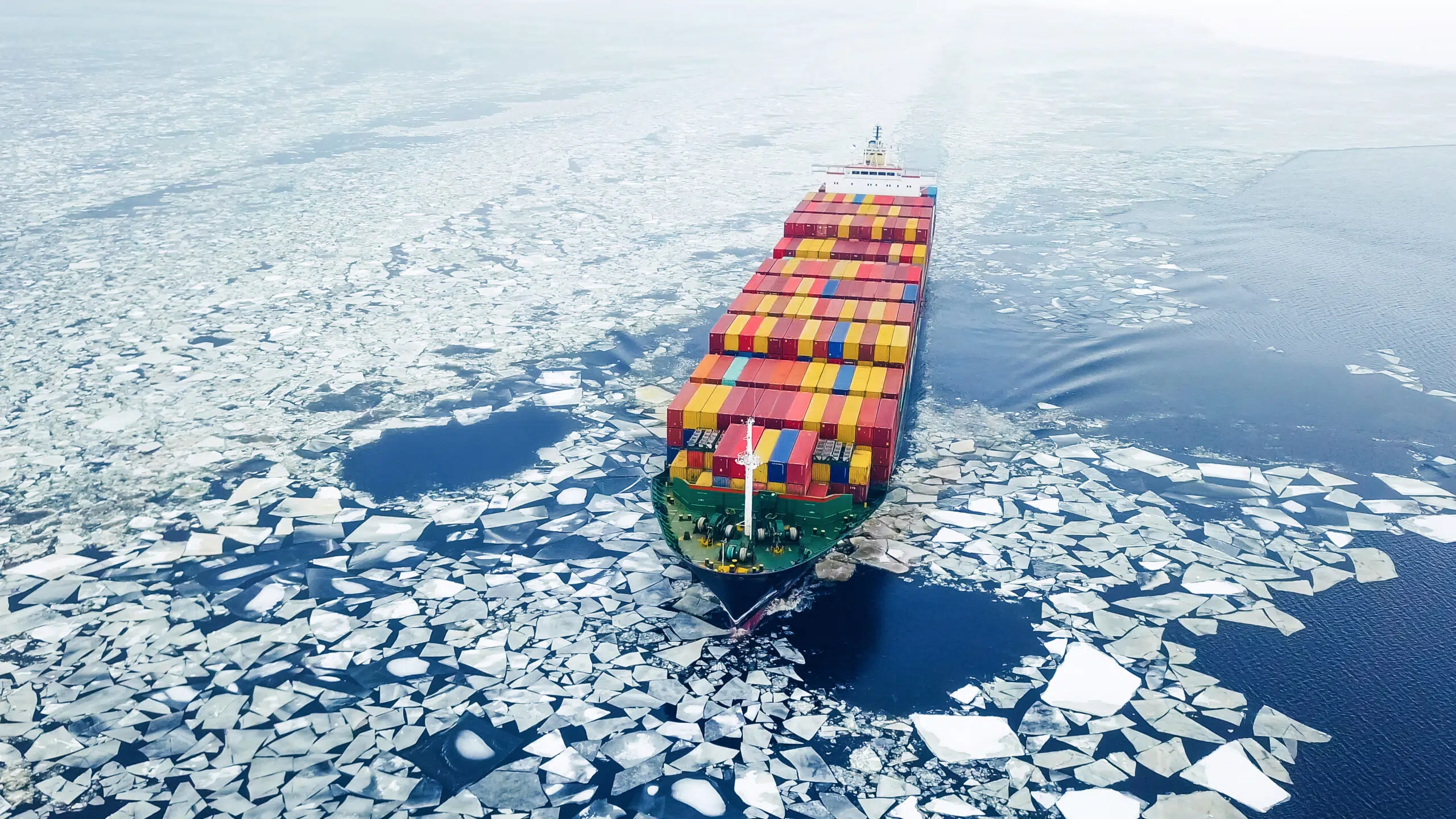
China is turning the Arctic into a new maritime highway for its battery and EV industries, opening a dramatically shorter route to European markets as conflict and disruption continue to plague traditional global shipping lanes.
Chinese carrier Sea Legend has begun regularising its China-Europe Arctic Express, following a successful trial voyage last year carrying Chinese electric vehicles and other high-value manufactured goods through Russia’s Northern Sea Route.
The attraction is speed. The Arctic passage can put cargo into northern Europe in around 20 days, compared with roughly 40 days through the Suez Canal and as much as 50 days when vessels are forced around Africa’s Cape of Good Hope.
For battery manufacturers — particularly those shipping high-value lithium cells, battery packs and EV components — cutting several weeks from the journey could have significant implications for inventory, working capital and European supply chains.
And what began as an experiment is becoming considerably more serious.
Temperature control
Sea Legend has scheduled eight consecutive weekly sailings from Ningbo-Zhoushan between August and October this year, deploying seven vessels compared with the single ship used for its 2025 trial.
Russian Information & Analytical Agency PortNews said on August 15 that Chinese lithium battery manufacturer EVE Energy will be among firms involved in some of the early shipments to test the transport chain for a small batch of power batteries, including temperature control and customs clearance, although Batteries International has not independently verified that report.
Batteries International can also confirm that South Korea is also exploiting the new route to lucrative European markets, with that country’s PanStar line setting off on a pilot trip through the Arctic on or around August 22.
PanStar has not disclosed detailed cargo inventories but confirmed it would be shipping “a wide range of products including automotive parts” on the voyage from Busan Port with subsequent onward journeys to Rotterdam in the Netherlands, Hamburg in Germany and Gdańsk in Poland.
Asia’s Silk Road tributary through the normally frozen Arctic wastes is in part thanks to climate change, which has made the region more navigable at certain times of the year.
Warm relations between Asian nations such as China and Russia — whose state-owned atomic energy corporation Rosatom is responsible for issuing shipping permits for the NSR — are also a major geopolitical factor.
Environmental concerns
The Mediterranean Shipping Company (MSC), the world’s largest container shipping line, has already ruled out operating any Asia-Europe services via the NSR.
The announcement came as the China-Europe Arctic Express initiative was launched in 2025.
MSC said while the NSR offered potential advantages — such as shorter transit times and lower fuel consumption — its stance underscored “risks and uncertainties” associated with the route, not least on environment and regulatory grounds.
Batteries International has seen the first batch of sailing schedules for the China-Europe Arctic Express that were released by the China Shipowners’ Association on July 29.
In addition to Sea Legend, voyages will be undertaken by China’s Xin Xin Shipping, Ningbo Hongkun Shipping, Dalian Trawind Shipping, Tianjin Yueqian Shipping and and Shanghai Dahua Shipping.
According to the published schedules, participating operators plan to deploy around 20,000 teu (20 foot equivalent unit) of container ship and multi-purpose vessel capacity, together with around 1.4 million deadweight tonnes (DWT) of bulk carrier capacity.
Sea Legend itself will run eight fixed weekly sailings though to early October, using seven vessels and targeting transit times of around 20 to 22 days.
According to the China National Shipping Service (CNSS), cargo will include lithium ion batteries, photovoltaic products and new energy vehicle/EV components.
Resilient supply chains
CNSS said the move will shorten trips between Chinese ports and key Baltic gateways by around a third, as businesses seek more diversified and resilient supply chains amid rising risks along traditional maritime routes.
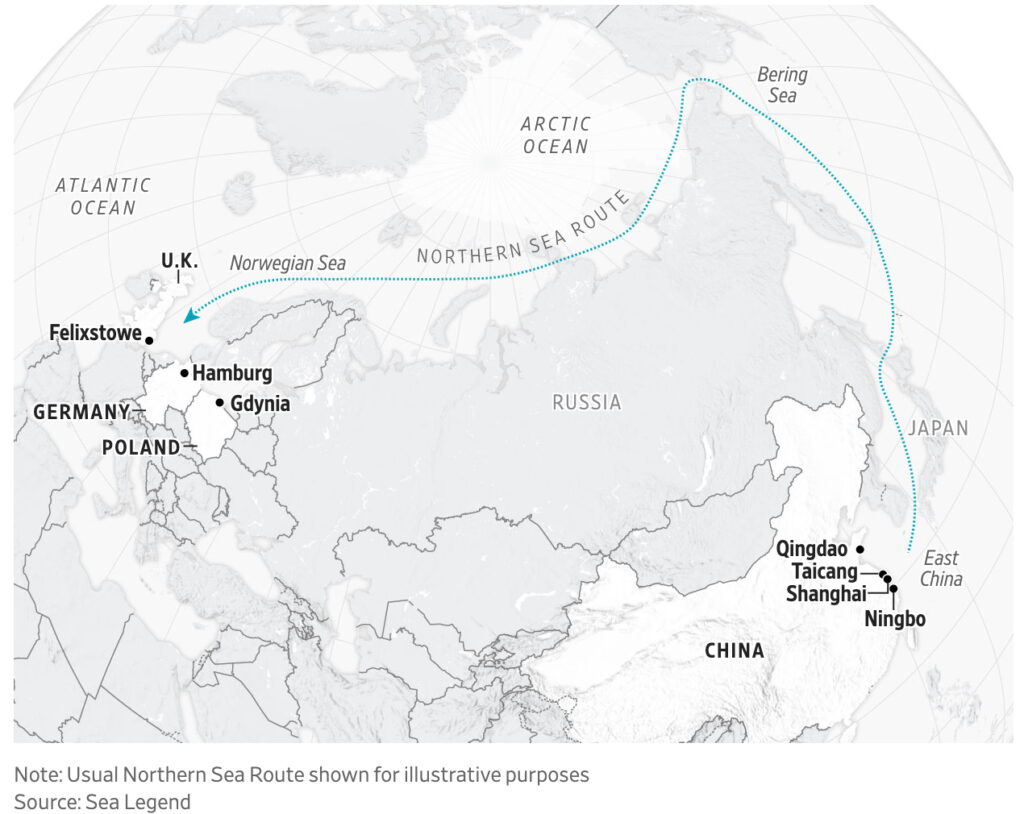
The new service will consolidate cargo from multiple Chinese ports before calling at Ningbo-Zhoushan Port and sailing for Felixstowe in the UK, with connections to other European ports including Rotterdam, Netherlands, Wilhelmshaven in Germany, and Poland’s Gdynia.
Industry calculations cited by CNSS claim the Arctic route can shorten the sailing distance on some Northeast Asia-Northern Europe services by around 30%-40%, compared with conventional seaways via the Suez Canal or the Cape of Good Hope.
Sea Legend has deployed seven container vessels ranging from 1,384 teu to 4,890 teu. The first sailing, to be operated by the Dubai Tower, was scheduled to leave Ningbo on August 15 and arrive at Felixstowe on September 7.
The Chinese Communist Party-backed Global Times claimed the Arctic’s “naturally low temperatures can be suitable for the transport of high-value goods such as energy-storage, helping reduce some temperature-related transport risks”. However, no firm scientific evidence was cited.
PanStar general manager Kang Sang-in has said the Korean pilot voyage offered an opportunity to open a new chapter for the country’s shipping industry.
“We have largely alleviated market concerns about the Arctic route, seeing it lead to actual bookings and confirming its commercial potential.”
The pilot will comprehensively verify operational safety and business viability and lead to a review of potential regular services using the Arctic in the future.
New energy vehicles
China’s state Xinhua news agency reported in September 2025 that Sea Legend had tested the viability of faster Arctic shipping with a single voyage last year with cargo mainly comprising new energy vehicles, lithium batteries and photovoltaic products.
The voyage from Ningbo-Zhoushan Port to Felixstowe was completed in around 20 days — despite reducing speed as a result of severe weather in the Norwegian Sea, Xinhua said.
According to Jian Junbo, director of the Center for China-Europe Relations at Fudan University’s Institute of International Studies, growing trade between East Asia and Europe is providing another source of momentum.
“As a rising share of China’s exports consists of higher-value advanced manufactured products, new Eurasian transport corridors have a stronger cargo base on which to develop.”
Hu Qimu, a professor at the Maritime Silk Road Institute of Huaqiao University, said traditional shipping routes still hold advantages in capacity, infrastructure and established networks, but rising geopolitical tensions had pushed up fuel and operating costs on some corridors, while tighter control over key ports had added to concerns over global shipping security.
“Against this backdrop, developing alternative corridors and building a more diversified shipping network have become an increasingly necessary choice.”
Gordon Chang, a distinguished senior fellow and member of the advisory board of the Gatestone Institute — a non-profit international policy council and think tank — said in analysis published on August 18: “For many reasons, the world’s biggest shipping companies do not sail the NSR. It is, for instance, not passable in winter, and even in summer ships can end up trapped in ice.
“Moreover, Russia, after its 2022 invasion of Ukraine, has been heavily sanctioned and most companies do not want to deal with Rosatom, which issues permits for the NSR.”
Marie-Caroline Laurent, group senior VP for maritime policy and government affairs at global container shipping company MSC, told the International Chamber of Shipping earlier this year that the firm would not use the NSR as a maritime trade route to transit the Arctic.
“There are significant safety, environmental and social issues surrounding trans-Arctic shipping. These issues also raise questions of the operational viability and economic case for the use of the NSR.
“While transit times may be reduced during a limited period of the year, any perceived gains are likely to be entirely outweighed by significantly higher costs, capacity restrictions, and the operational uncertainty inherent to the route — particularly due to heightened geopolitical tensions.”
Sanctions complications
Meanwhile, insurer Allianz Commercial said in its 2026 safety and shipping review that sanctions imposed on Russia after the invasion of Ukraine could complicate rescue efforts if a vessel gets into trouble in the Arctic and requires assistance.
According to Allianz, the Arctic economy has tripled in size since 2003 to more than $650 billion, driven by resource extraction, trade route development and increased investment, particularly from Russia.
Allianz analysis showed that machinery damage or failure was the cause of almost half of the 500+ reported shipping incidents in Arctic Circle waters over the past decade.
Image credits: Envato
Advertisement

Advertisement